





In brief
- Situation
- NextDimension AI was about to launch its first cold outbound campaign to specialty practices, with most new deals still coming from referrals.
- Problem
- Its workflow ran across Clay, Apollo, Smartlead and Sales Navigator, with two steps done by hand and three AI columns guessing at practice data, including the EHR.
- Decision
- After dropping Definitive Healthcare and passing on ZoomInfo, the team stopped building on Clay and moved to one healthcare platform.
- Result
- Practices filtered by EHR, the physicians and executives at each site of care, their contacts, warm introductions and sending in one Dmand AI login.
The decision point
In June 2026, NextDimension AI was about to start cold outbound on a four-tool stack
NextDimension AI first spoke with Dmand AI in June 2026, on the day it planned to launch its first cold outbound campaign. Most new deals still came from referrals by advisors, investors and customers, and the commercial team wanted a steadier second source of pipeline.
The team had already built an outbound stack: a Clay workbook for research, Apollo for contacts, Smartlead for sending and LinkedIn Sales Navigator for executives. The question was whether to keep improving it or move to one platform, knowing that every switch costs time.
“Every new tool, with all due respect, comes with some new learning curve and challenges.”
About NextDimension AI
- Website
- nextdim.io
- What it sells
- AI agents that run front office work for specialty practices: patient calls, procedure prep and prior authorizations
- Sells to
- Owner physicians and executives at procedure-heavy specialty practices: GI first, then dermatology, ophthalmology and radiology
- Where it started
- Gastroenterology, where its flagship customers are
- Replaced
- Clay, Apollo, Smartlead and LinkedIn Sales Navigator
- Published
Used in Dmand AI
The market
NextDimension sells to 7,450 specialty groups, and MSOs own more than 1 in 5 of the large ones
NextDimension’s buyers run procedure-heavy specialty practices, where the front office carries the patient calls, procedure prep and prior authorizations its agents take over: gastroenterology first, then dermatology, ophthalmology and radiology, including groups that private equity owns through a management services organization (MSO).
In Dmand AI, 7,450 single-specialty groups in those four specialties sit outside health systems. 1,881 have 15 or more practitioners, and MSOs own 422 of them.
At each practice the team sells to two groups of people: the physicians who own and run it, and its executives, from the C-suite to operations and IT leaders at manager level and above. Dmand AI holds about 11,000 of those executives at these groups and the organizations that own them.
Where NextDimension’s buyers are
Single-specialty groups outside health systems, one dot per group at its ZIP code, November 2026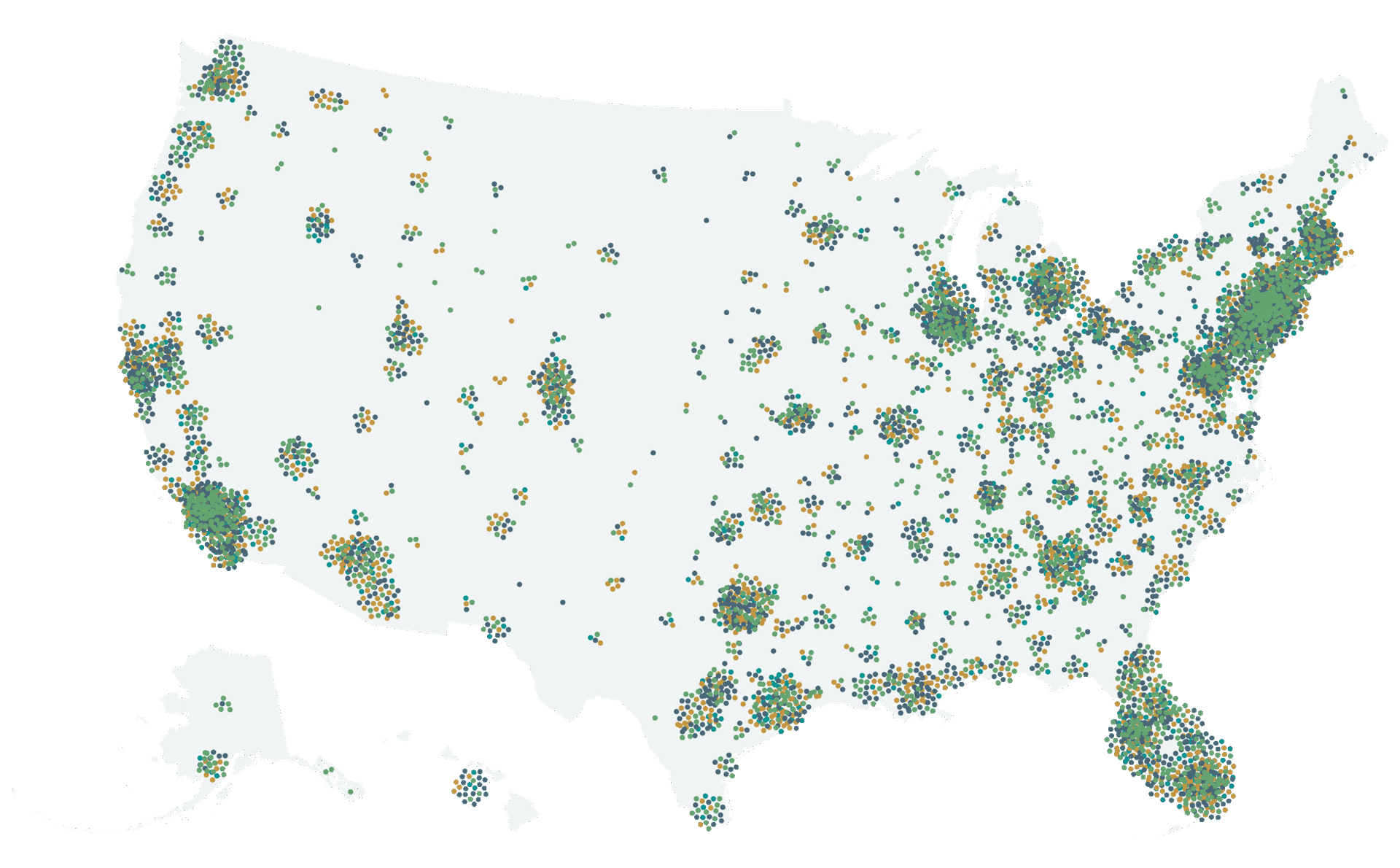
United States7,450 groups
Point at or tap a state to see its groups, or pick it from the list. Press a specialty to show only its groups.
United States: 7,450 groupsGroups by state
| State | Ophthalmology | Radiology | Dermatology | Gastroenterology | Total |
|---|---|---|---|---|---|
| California | 326 | 230 | 236 | 98 | 890 |
| Florida | 226 | 206 | 166 | 68 | 666 |
| New York | 203 | 160 | 139 | 68 | 570 |
| Texas | 186 | 137 | 160 | 62 | 545 |
| New Jersey | 108 | 97 | 76 | 33 | 314 |
| Pennsylvania | 122 | 68 | 57 | 26 | 273 |
| Illinois | 99 | 76 | 49 | 34 | 258 |
| Michigan | 98 | 67 | 69 | 23 | 257 |
| Georgia | 57 | 64 | 45 | 28 | 194 |
| Virginia | 60 | 50 | 63 | 15 | 188 |
| North Carolina | 58 | 56 | 55 | 18 | 187 |
| Massachusetts | 64 | 33 | 57 | 25 | 179 |
| Ohio | 70 | 46 | 40 | 22 | 178 |
| Arizona | 47 | 47 | 60 | 20 | 174 |
| Maryland | 59 | 38 | 42 | 16 | 155 |
| Colorado | 44 | 37 | 51 | 11 | 143 |
| Louisiana | 62 | 36 | 34 | 9 | 141 |
| Washington | 50 | 42 | 41 | 5 | 138 |
| Tennessee | 54 | 46 | 25 | 11 | 136 |
| Alabama | 34 | 46 | 30 | 11 | 121 |
| Indiana | 45 | 46 | 17 | 10 | 118 |
| Missouri | 48 | 30 | 29 | 11 | 118 |
| Connecticut | 30 | 41 | 26 | 12 | 109 |
| Oregon | 34 | 31 | 22 | 5 | 92 |
| South Carolina | 36 | 20 | 30 | 6 | 92 |
| Kentucky | 23 | 28 | 21 | 2 | 74 |
| Utah | 32 | 15 | 24 | 2 | 73 |
| Oklahoma | 24 | 26 | 16 | 4 | 70 |
| Mississippi | 27 | 22 | 15 | 3 | 67 |
| Nevada | 23 | 24 | 13 | 6 | 66 |
| Minnesota | 28 | 18 | 15 | 0 | 61 |
| Wisconsin | 21 | 28 | 6 | 6 | 61 |
| Arkansas | 23 | 15 | 11 | 6 | 55 |
| Kansas | 24 | 17 | 9 | 3 | 53 |
| Iowa | 15 | 22 | 14 | 1 | 52 |
| Idaho | 20 | 14 | 9 | 6 | 49 |
| Nebraska | 17 | 17 | 6 | 0 | 40 |
| Alaska | 7 | 22 | 6 | 3 | 38 |
| Rhode Island | 12 | 7 | 6 | 10 | 35 |
| New Hampshire | 10 | 14 | 5 | 3 | 32 |
| Delaware | 13 | 12 | 5 | 1 | 31 |
| New Mexico | 10 | 8 | 9 | 2 | 29 |
| West Virginia | 6 | 14 | 6 | 3 | 29 |
| District of Columbia | 9 | 3 | 12 | 2 | 26 |
| Hawaii | 16 | 3 | 4 | 3 | 26 |
| Maine | 10 | 11 | 4 | 1 | 26 |
| Montana | 7 | 9 | 8 | 0 | 24 |
| Wyoming | 1 | 13 | 4 | 2 | 20 |
| South Dakota | 8 | 4 | 4 | 0 | 16 |
| Vermont | 7 | 2 | 5 | 1 | 15 |
| North Dakota | 7 | 3 | 0 | 0 | 10 |
Groups drawn on the map, by the state of their ZIP code. The states add up to 7,314: the other 136 groups have no usable ZIP code or are in Puerto Rico, so the national counts above are higher.
Ownership is what a domain list hides. An MSO sits above the practice, and one practice can run several sites under several web domains. Org Hierarchy Explorer shows the MSO, each group it owns and every site under the group.
Large groups owned by an MSO
Single-specialty groups with 15 or more practitioners, by owner, November 2026- Owned by an MSO
- Other owners
- Dermatology290 groupsOwned by an MSO 34%, Other owners 66%
- Ophthalmology374 groupsOwned by an MSO 31%, Other owners 69%
- Gastroenterology172 groupsOwned by an MSO 30%, Other owners 70%
- Radiology1,045 groupsOwned by an MSO 15%, Other owners 85%
One practice, three web domains. A list keyed by domain counts it as three accounts and misses the MSO above it.
Who NextDimension sells toAt the group, its sites and its MSO
- MPOwner physiciansManaging partners and medical directors
- CSC-suiteCEO, COO and CFO
- OPOperations leadersPractice administrators and up
- ITIT leadersIT managers and up
The problem
NextDimension’s four-tool workflow found a usable email for 50 of 170 leads
The team built its workflow in a Clay workbook. Getting from a list of practices to a sent email took eight steps across four tools: two of them by hand, and three AI columns guessing at data that a healthcare database already holds.
| Step | What happened | Done by |
|---|---|---|
| Build the practice list | Exported from Apollo. | Apollo |
| Copy each provider page | By hand, from each practice website, so the AI would not misread it. | By hand |
| Pull the roster | A Clay AI column turned each page into a list and dropped nurses and other roles. | Clay AI column |
| Pick the decision makers | A second, more expensive AI column chose the top five or six people. | Clay AI column |
| Find the executives | By hand in Sales Navigator, one practice at a time, saved to an Apollo list. | By hand |
| Guess the EHR | A third AI column read patient portal links and predicted the vendor. | Clay AI column |
| Find emails | Apollo first, then fallback email finders, merged into one column. | Apollo |
| Send | A CSV exported to Smartlead, three templated emails three days apart. | Smartlead |
| Result | 50 usable emails from a 170-person list | |
The output was thin. On that list the workflow found emails for 100 people, and Smartlead’s check marked half of them invalid. Across target accounts, about 40% of the people the team could name had no working email, and a personal email to a high-priority practice took about an hour of research.
“We know their names, we know who they are, but no great way of getting in front of them.”
Because the workbook keyed accounts by web domain, a site that belonged to a current customer could also land on the target list.
The options
NextDimension weighed Definitive Healthcare, ZoomInfo, an in-house build and one platform
The team had already dropped Definitive Healthcare after an extensive review, and ZoomInfo was out of budget. It had also started to think about building the missing pieces itself. Meanwhile Clay had become the most expensive part of the stack.
| Option | In their words | Outcome |
|---|---|---|
| Keep building on Clay | “This is an enterprise tool now. This is not a startup friendly tool anymore.” | Dropped |
| Add ZoomInfo | “A bit out of budget.” | Passed |
| Buy Definitive Healthcare | Dropped after an extensive review. | Dropped |
| Build it in-house | “We were thinking of eventually Claude coding our way into this whole thing.” | Not needed |
| Dmand AI | “Look, I’m pretty much sold. We should get started.” | Chosen |
What decided it was a walkthrough of the team’s Clay workbook. Dmand AI answered with the GI market, physician first: gastroenterologists in groups of 10 to 40, at ambulatory surgery centers, each tied to its group and the site where they practice. Within minutes the commercial lead had found an endoscopy center in a region the team was not targeting.
“You are basically saying, go bottoms up, physician to account. We are in the mindset of going account to physician. I can see how bottoms up, you’re able to gather all this additional data, which is actually helpful.”
The team bought the $249 Kickstarter plan in the app before that call ended.
What they did
NextDimension now works down from the specialty market to each physician and executive, in five steps
Every campaign now runs the same five steps in one Dmand AI login, from the practices worth a call to a first email ready for review.
Find the practices on the EHRs NextDimension’s agents work inside
Lists start in Dmand AI’s medical group search: specialty, size, owner, state and the EHR each group runs. NextDimension’s agents work inside the practice’s own systems, so the EHR filter keeps the list to practices the agents can work in, and the team sees how big a segment is before it spends a credit.
Go down to each site of care and the people who work there
Each group opens to its sites of care, from offices to endoscopy centers, and to the MSO above it. Dmand AI ties every physician and executive to the site where they work, not only to the group, and the EHR filter works at that level too: the physicians who practice at sites on a given EHR, and the managing partners, administrators and operations leaders who decide.




Get verified contacts for the people who decide
Contacts come from waterfall contact enrichment, which checks healthcare-specific sources in turn for each physician and executive and verifies the email before a sequence sends to it. The team pays for the contacts it picks, not for a list.
40%better healthcare contact coverage than ZoomInfo and Apollo, the tools NextDimension had used or priced for contacts.Dmand AI’s benchmark of waterfall contact enrichment, not a NextDimension result.
Turn advisors into warm introductions with Physician Network Discovery
Introductions from advisors, investors and customers were still NextDimension’s best source of deals, but asking for one depended on who happened to remember whom. On the first call, the commercial lead ran Physician Network Discovery on one of the team’s own physicians and called the result “very, very valuable.”
Now the team adds the physicians it already knows, its physician advisors and the physicians at its customers, and Discover Network lists the physicians they connect to: who trained in the same program, wrote papers together or work at the same group or hospital, with a connection strength from 0 to 100. Before asking for an introduction, the team brings the advisor a short list and one question.
“Do you actually know these people?”
The same check runs before the team brings on a new physician advisor, to see which practices that advisor’s network reaches. The team has used Physician Network Discovery regularly since June.
Let Zeus AI SDR draft the first email, sent from domains the team owns
Zeus AI SDR researches each person and practice and drafts the first email from what Dmand AI holds: the role, the site, the EHR and any new signal. The team reviews every draft before it sends. At onboarding, the Dmand AI team set up sending with NextDimension around four choices.
- Domains the team owns
New domains bought for outbound, so their reputation stays with NextDimension if tools change.
- Mailboxes warmed up first
About ten days of slow, rising volume before the first campaign email.
- A short first email
Three emails in a sequence. The first one asks a question and carries no links.
- Senior senders
Mailboxes for company leaders, since emails from senior people tend to get more replies.
- 1The right personThe practice administrator runs the front desk the agents take over.
- 2A new siteAn expansion signal on the group’s page.
- 3The EHR at the siteFrom the site’s profile, not a guess from its patient portal.
- 4One question, no linksThe first-email rule the team set at onboarding.
- First callPhysician Network Discovery, tried on one of the team’s physicians, on the day the first cold campaign was due to launch
- Next dayA walkthrough of Zeus AI SDR and of asking advisors for introductions
- 8 days laterClay workbook review, the GI market by group size, and the plan bought in the app
- 3 weeks laterOnboarding: new domains, warmed-up mailboxes and the first campaign
- 2 months laterThe co-founder and CEO gives Dmand AI 5 stars in a review on G2
What happened
NextDimension now runs its specialty outbound from one login, for less than half the cost
Clay was the first tool to go, and the other three followed. The practices, the people at each site, their contacts, warm introductions, research and sending now sit in one login, and the money that went to AI columns guessing at rosters and EHRs no longer leaves the budget.
Monthly cost of outbound tools
$800Before$300AfterTools in the workflow
4Before1AfterData lookups done by hand
2Before0AfterAI columns guessing at practice data
3Before0After
Before: monthly list prices for Clay, Apollo, Smartlead and LinkedIn Sales Navigator, and the team’s own counts. After: the Dmand AI Kickstarter plan with mailboxes and domains. Rosters, executives, decision makers and the EHR now come from each group’s and site’s page in Dmand AI instead of copied web pages, Sales Navigator and AI columns.
| The job | Before | With Dmand AI |
|---|---|---|
| Size the market | Unknown: a search showed results, not how many groups exist | Every specialty group, by size, owner, EHR and site of care |
| Define the account | A web domain, sometimes three per practice | The group, its MSO and its sites of care in Org Hierarchy Explorer |
| Find the EHR | Guessed by an AI column from patient portal links | On each group’s and site’s profile, and a filter for practices and physicians |
| Find the people | Sales Navigator by hand, one practice at a time | The physicians and executives tied to each site of care |
| Find emails | Apollo, then fallback finders, then a separate check | Waterfall contact enrichment, verified before sending |
| Warm introductions | Asking advisors and investors who they happened to know | A list of who each advisor knows, from Physician Network Discovery |
| Write and send | CSV export to Smartlead, on a domain Smartlead held | Zeus AI SDR drafts, and email goes out from NextDimension’s own domains |
I love how it automatically researches prospects and writes hyper-personalized emails, saving me hours every day by eliminating manual research. […] The real value is speed and scale, as I can reach significantly more prospects every week with personalized, high-converting messages that don’t look like generic automated spam.

Next, the team plans to take the same playbook beyond GI, to the 6,718 dermatology, ophthalmology and radiology groups in its market.
Lessons for your team
Four lessons for small teams selling to specialty practices
Size the market before you build a list
Work down from specialty, size, owner and EHR to each group and its sites. NextDimension’s market turned out to be four specialties, not one, and at MSO-owned groups the person who decides may sit above the practice.
Ask your teamHow many practices fit your ideal customer profile, and who owns each one?
Count usable emails, not found emails
A source that returns plenty of emails can still leave you with few you can send to. Judge a data source by what survives verification, not by how many rows it returns.
Ask your teamOf every 100 people on your list, how many can you actually email?
Stop paying AI to guess what healthcare data already holds
Three of the eight old steps were AI columns guessing at rosters, decision makers and the EHR. A healthcare database already holds those facts at each site of care, so the AI can go to research and writing instead.
Ask your teamWhich steps in your workflow are guesses at facts you could look up?
Bring advisors a list, not a favor
An advisor who is asked “do you know anyone at Kestrel?” has to remember. An advisor shown the physicians their training, papers and practices connect them to only has to say yes or no.
Ask your teamWhich of your advisors’ colleagues are already on your target list?