

Short Answer
ZoomInfo is a B2B database built for every industry. It doesn't publish prices, and Vendr puts the median contract at $33,500 a year. Its data catalog has no healthcare dataset, and each contact links to one company, not to a site of care. If you sell into hospitals, health systems or medical groups, Dmand AI gives you HCPs and executives at the right site, warm paths through Network Discovery and outreach in one login, from $249 per user per month.
| ZoomInfo fits if you | Dmand AI fits if you |
|---|---|
| Sell to many industries, with healthcare as one of them | Sell into US hospitals, health systems, medical groups or clinics |
| Mostly target finance, IT and procurement roles at health systems | Need physicians, nurses and executives tied to the right site of care |
| Want intent data and website visitor tracking across every account | Want warm intros into accounts through Network Discovery |
| Already budget for an annual, custom-quoted contract | Want published pricing, outreach in the same login and no contract |
Key Takeaways
- ZoomInfo doesn't publish prices. Vendr reports a median contract of $33,500 a year, with deals from $7,220 to $155,730.
- ZoomInfo's data catalog lists 25 datasets, 12 of them for specific industries. None covers healthcare.
- ZoomInfo's published contact fields link each person to one company. There's no NPI or specialty field.
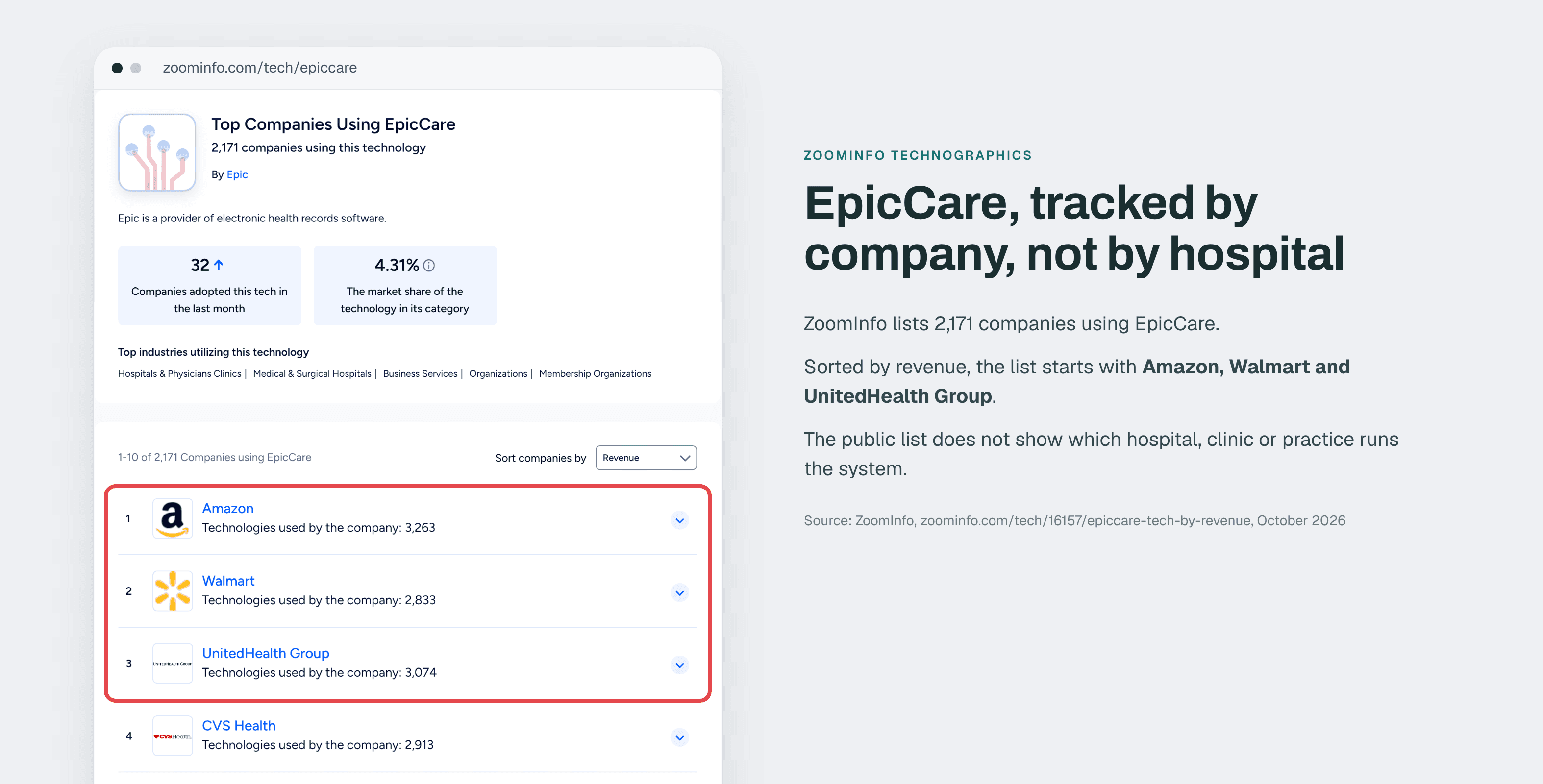
- ZoomInfo tracks EHR products by company. Its EpicCare list is led by Amazon, Walmart and UnitedHealth Group.
- Dmand AI maps 7.4M+ HCPs and 11M+ healthcare executives to 997K+ sites of care under 1.6K+ health systems and IDNs.
- Dmand AI starts at $249 per user per month, with a 30-day free trial and no contract.
ZoomInfo healthcare data: what it covers for hospitals, health systems and physicians
ZoomInfo (Nasdaq: GTM) sells B2B contact, company and intent data to every industry. It reported $310.4M in revenue for Q2 2026, up 1.2% year over year.
ZoomInfo says it has 500M+ professional profiles, 122M+ companies and 300M+ verified business emails. Healthcare is one industry in that pool.
ZoomInfo products in 2026
- GTM Workspace: the seller workspace for account lists, AI-drafted emails and CRM updates.
- GTM Studio: where marketing and RevOps teams build and launch campaigns.
- Copilot, Intent and WebSights: account scoring, buying signals and website visitor tracking.
- Chorus: call recording and conversation intelligence.
- GTM.AI: API and MCP access to ZoomInfo data.
Does ZoomInfo have a healthcare dataset?
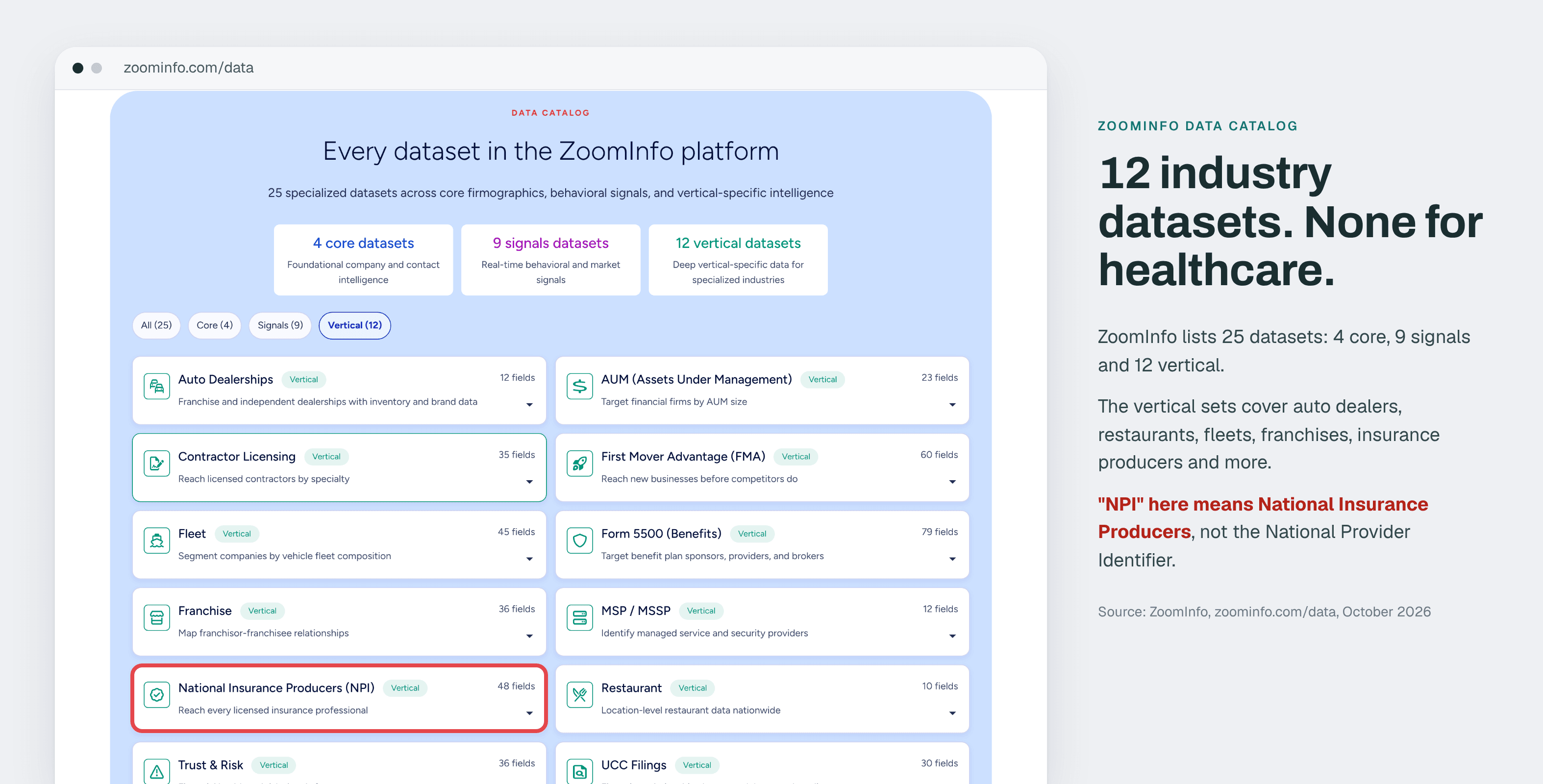
No. ZoomInfo's data catalog lists 25 datasets, including 12 for specific industries like auto dealers, fleets, restaurants and insurance producers. None covers hospitals, physicians or other care providers.
Watch the naming. The dataset labeled "NPI" in ZoomInfo's catalog is National Insurance Producers, not the National Provider Identifier.
ZoomInfo files hospitals and clinics under one industry, Hospitals & Physicians Clinics, and ranks health systems as single companies by revenue.
What ZoomInfo includes and doesn't list for healthcare
Here's what ZoomInfo publishes about its data, and what it doesn't list, as of October 2026.
| Included | Not listed |
|---|---|
| Company revenue, headcount, industry and SIC/NAICS codes | Bed count, CCN or service lines |
| Corporate parent and subsidiary hierarchy | IDN to hospital to site-of-care hierarchy |
| Contacts with title, function, seniority, email and phone | NPI or clinical specialty |
| One company per contact | Affiliations at more than one site of care |
| EHR and other technology, tracked by company | Technology installs by hospital or clinic |
| Intent signals across 4,500+ topics | Medicare claims, procedure volumes or quality metrics |
| Department org charts | Net patient revenue or payer mix |
ZoomInfo pricing in 2026: what healthcare sales teams pay
ZoomInfo doesn't publish prices. It quotes every deal on seats, products, data credits and contract length.
Vendr tracks real software purchases. For ZoomInfo, it reports:
- Median contract: $33,500 a year
- Range: $7,220 to $155,730 a year
- Sample: 1,574 purchases, with buyers saving 22% on average
How does ZoomInfo pricing work?
You pay a platform fee plus a fee per seat, and you get a set number of data credits. Intent data, Chorus, website visitor tracking and advanced API access often cost extra, per Vendr.
That may change. On its Q2 2026 earnings call, ZoomInfo said seat-based customers will be able to switch to prepaid consumption pricing.
Does ZoomInfo offer a free trial?
Yes. ZoomInfo offers a 7-day trial and ZoomInfo Lite, a free tier with 10 export credits a month, according to ZoomInfo.
Dmand AI's trial runs 30 days. It previews the full US healthcare dataset, fully searchable with trial credits.
What to ask before you sign or renew ZoomInfo
Vendr reports that most ZoomInfo deals are prepaid annually, auto-renewal is common with 5 to 10% yearly increases, and notice periods run 30 to 90 days. Get these answers in writing:
- How long is the term, and does it renew on its own?
- What's the last day to give notice?
- Is the yearly increase capped?
- Do unused credits roll over?
- What does a credit cost after you run out?
- Can you drop seats at renewal?
ZoomInfo vs Dmand AI pricing
Dmand AI publishes its prices. A five-seat Kickstarter team pays about $15,000 a year at monthly rates, or about $12,000 billed annually.
| Dimension | ZoomInfo | Dmand AI |
|---|---|---|
| Published prices | No, custom quotes | Yes, on dmand.ai/pricing |
| Typical cost | Median $33,500 a year (Vendr) | Kickstarter $249, Growth $499 per user per month |
| Free option | ZoomInfo Lite, 10 export credits a month | 30-day free trial |
| Trial | 7 days | 30 days, full dataset preview |
| Contract | Annual, often auto-renewing (Vendr) | No contract |
| Billing | Annual prepayment is standard (Vendr) | 10% off half-yearly, 20% off annual |
| Data credits | Set by contract; overages cost extra (Vendr) | 1,000 on Kickstarter, 2,500 on Growth; $49 per 500 extra |
| Enterprise | Custom quote | Custom pricing above 10 seats |
Preview the data before your ZoomInfo renewal
Search the full US healthcare dataset free for 30 days. Check your own accounts, sites and HCPs before you sign another annual contract.
ZoomInfo data accuracy for physicians, nurses and hospital executives
ZoomInfo reports 96% email deliverability and 87% mobile accuracy. Those numbers tell you a contact is reachable.
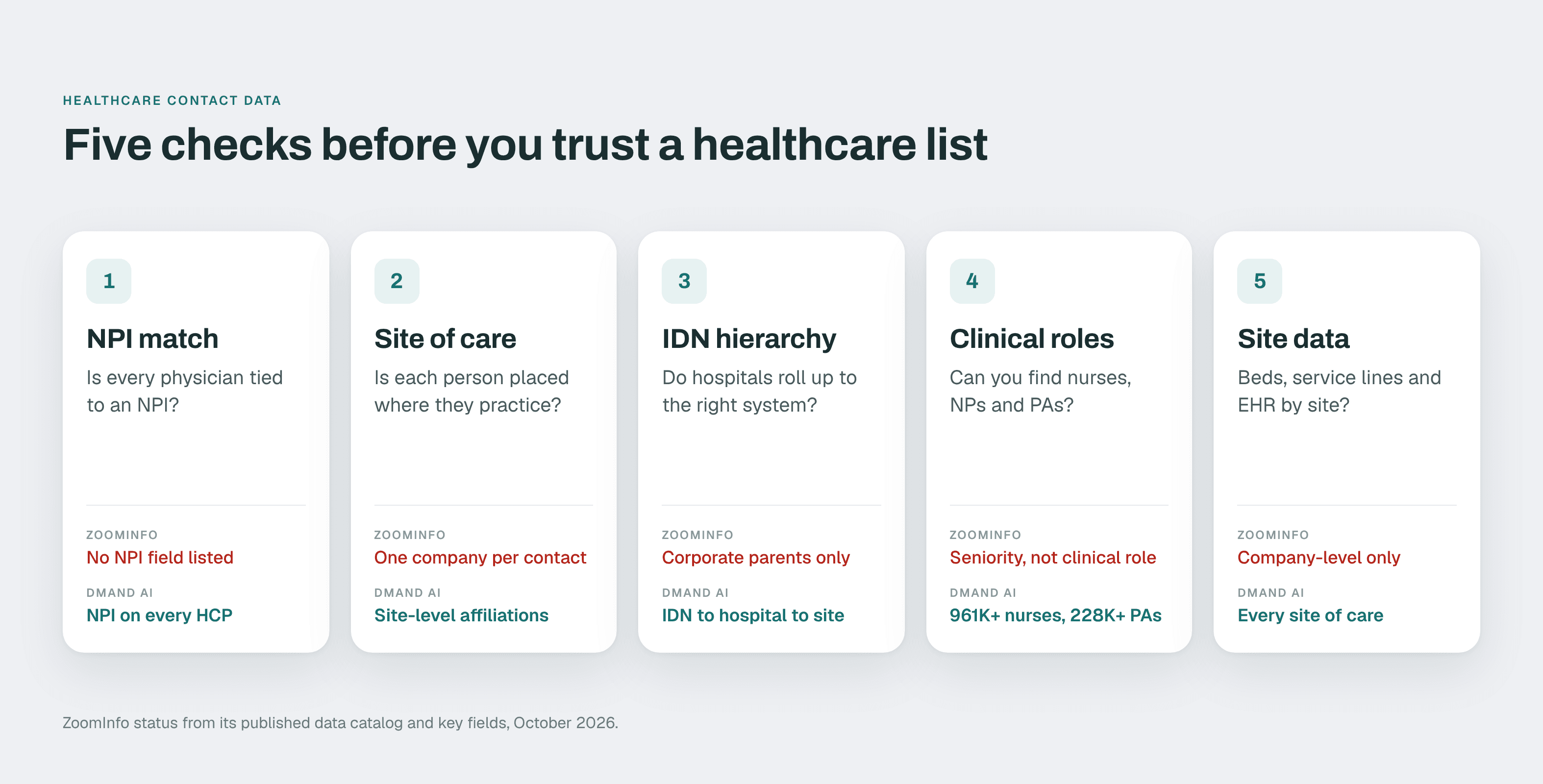
In healthcare, a reachable contact can still be the wrong person. A physician can hold privileges at a hospital, belong to a medical group and see patients at a clinic. Run these five checks on any healthcare contact data.
1. Does ZoomInfo link physicians to their NPI?
ZoomInfo's published contact fields don't include an NPI. Without one, two physicians with the same name in the same state look identical.
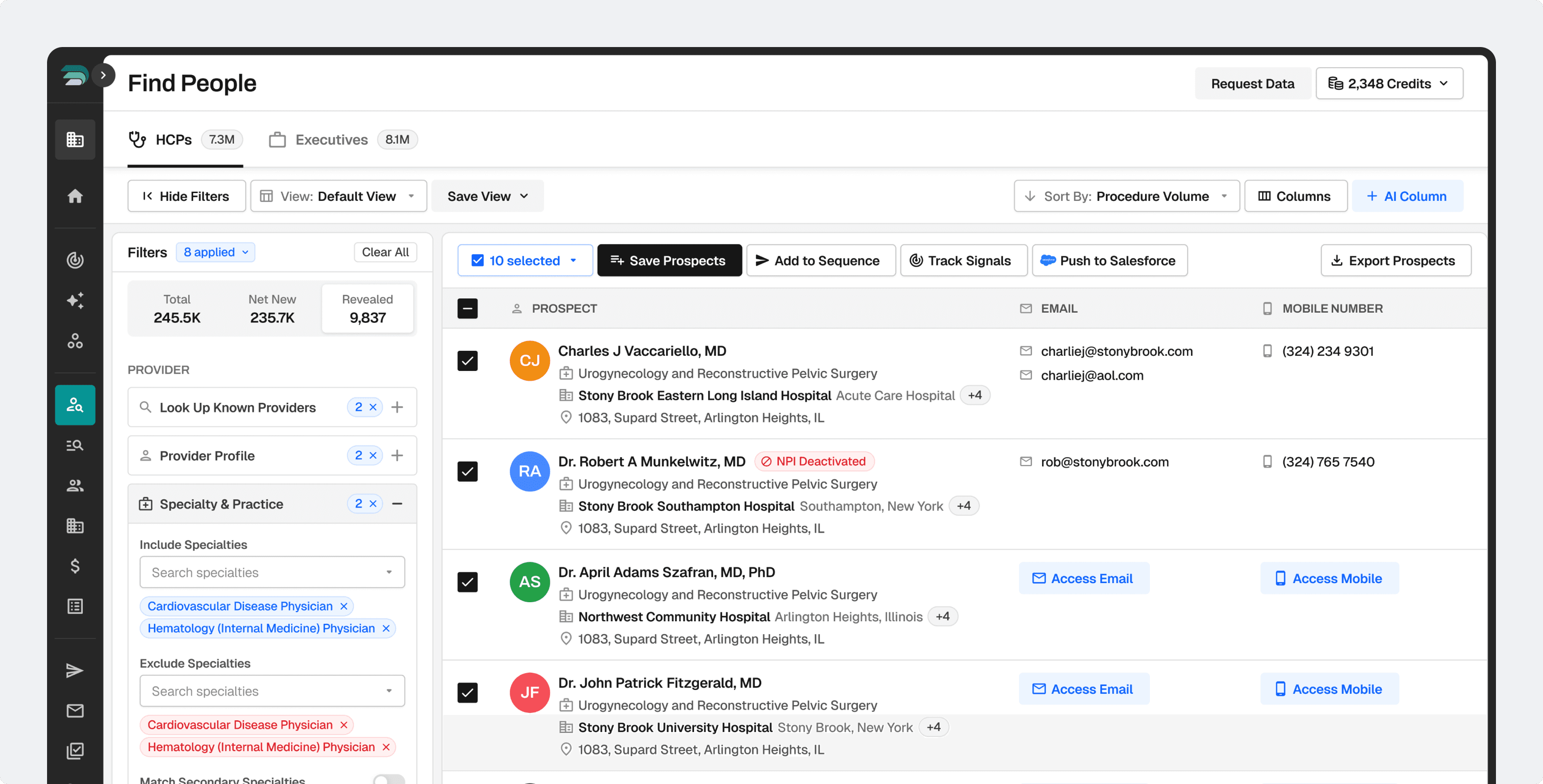
Dmand AI ties every one of its 7.4M+ HCPs to an NPI, and affiliates each one to the sites where they practice: hospitals, clinics, medical groups and other sites of care.
Then our waterfall enrichment finds the right contact details for each HCP: professional email, personal email, direct dial and LinkedIn. Dmand AI covers 2x the healthcare contacts of ZoomInfo and Apollo, with better accuracy.
2. Does ZoomInfo show where a physician practices?
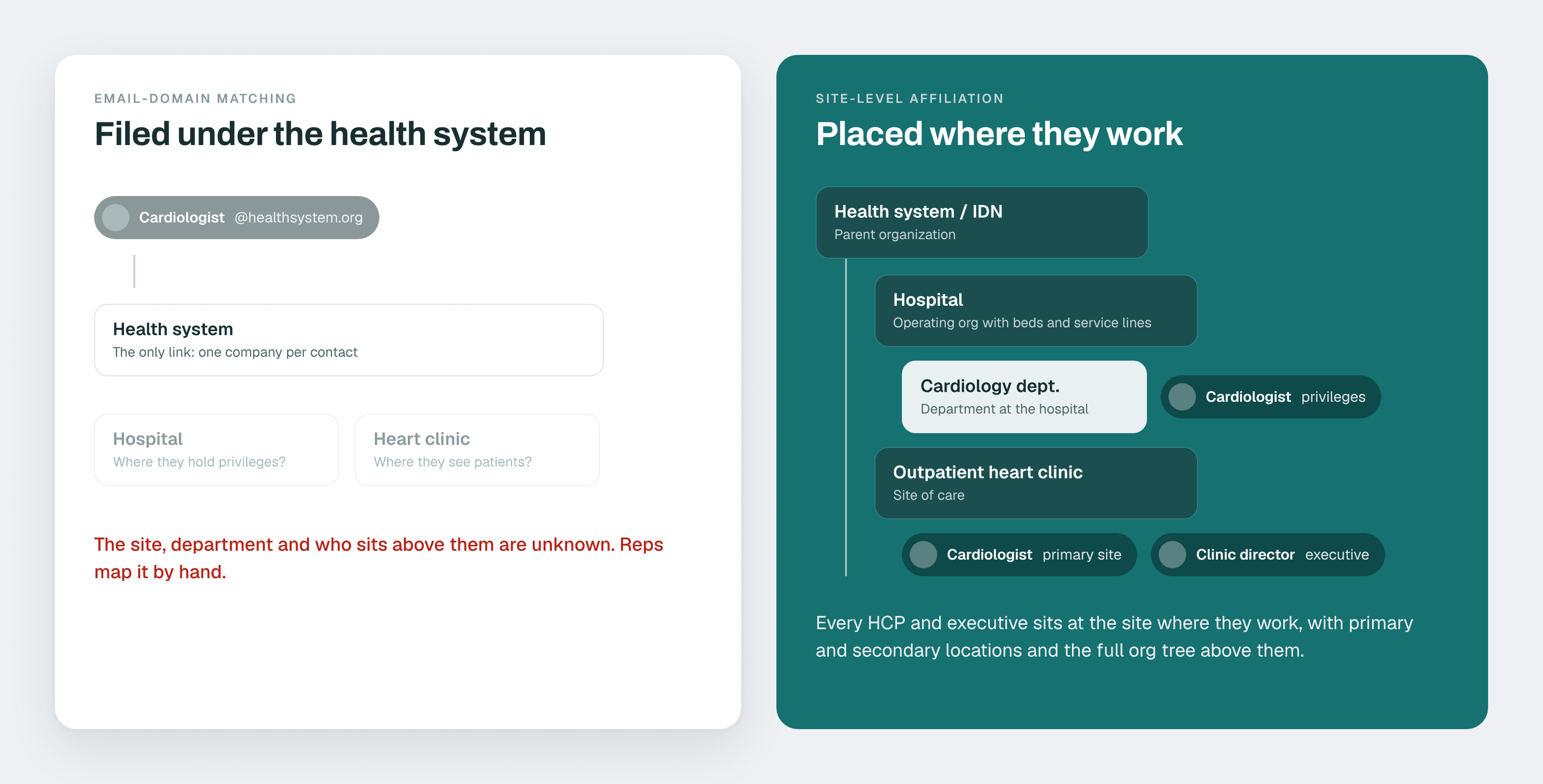
ZoomInfo links each contact to one company, usually the one behind their email domain. For a physician at a large system, that's the system, not the clinic where they see patients.
Dmand AI places every HCP and executive inside the health system's org tree:
- Health system or IDN at the top
- Hospitals, medical groups and operating orgs under it
- Departments, outpatient sites and clinics under those
- People at the site where they work, with primary and secondary locations
So you see where a physician practices, who runs that site and who signs above them.
3. Does ZoomInfo map hospitals to their health system?
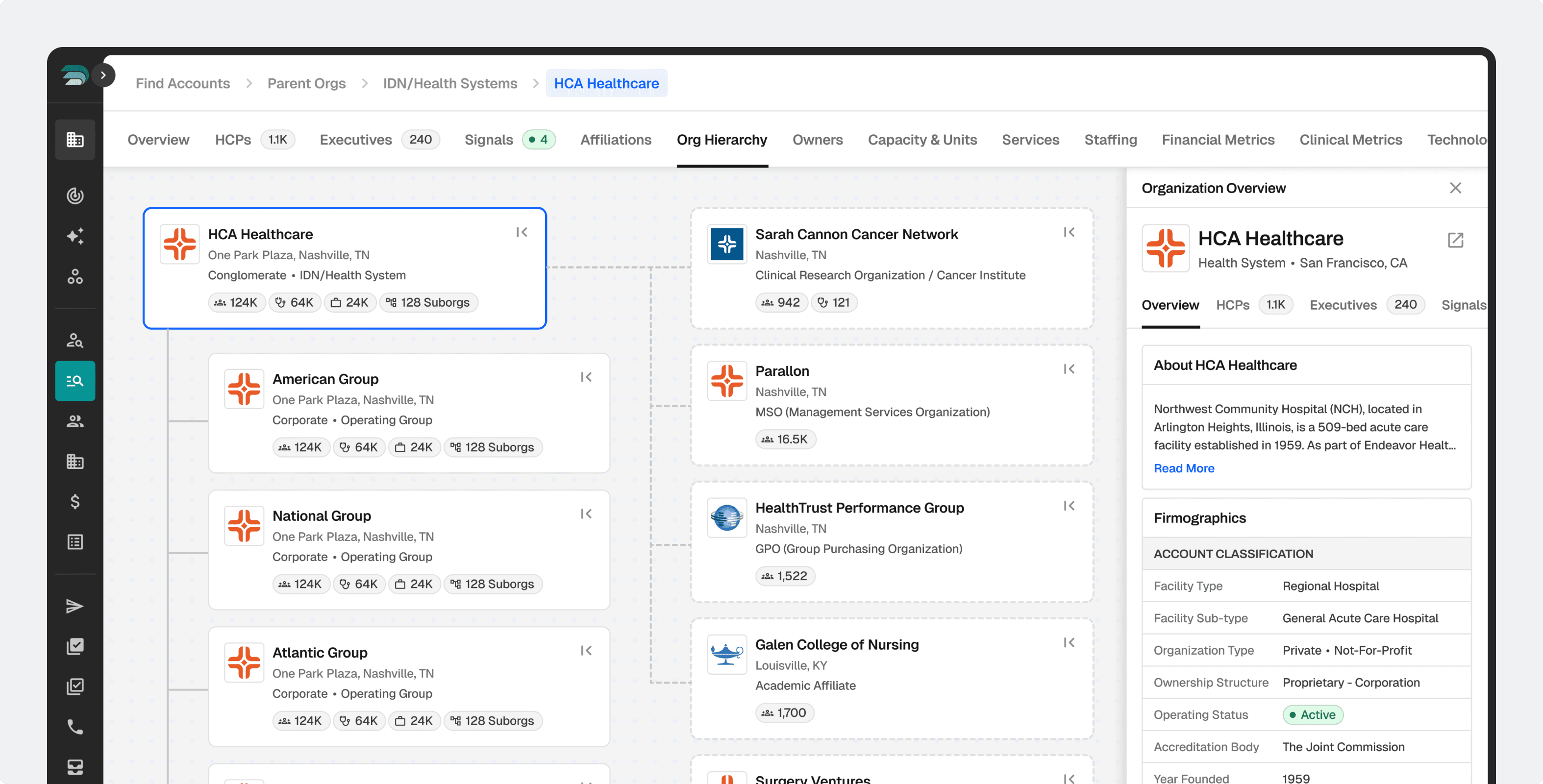
ZoomInfo maps corporate parents and subsidiaries. It doesn't publish a healthcare tree from the IDN down to each hospital, department and outpatient site. One ZoomInfo user on TrustRadius listed mapping hospitals to their health system as a con.
Dmand AI maps 1.6K+ health systems and IDNs to 6.2K+ hospitals, 22K+ hospital outpatient departments and units, and 997K+ sites of care.
4. Does ZoomInfo cover nurses and advanced practice providers?
ZoomInfo breaks its contacts down by seniority, not by clinical role, so you can't see how many nurses or physician assistants it covers.
Dmand AI covers 1.37M+ physicians, 961K+ nurses (RN, LPN and APRN) and 228K+ physician assistants, each tied to an NPI.
5. Does ZoomInfo show beds, service lines and EHR by site?
ZoomInfo tracks EHR products by company. Its EpicCare list shows 2,171 companies, led by Amazon, Walmart and UnitedHealth Group when sorted by revenue.
Bed counts, service lines, quality metrics and net patient revenue don't appear in ZoomInfo's published catalog. One G2 reviewer working with health systems asked ZoomInfo for net patient revenue and Medicare revenue, the numbers their team targets on.
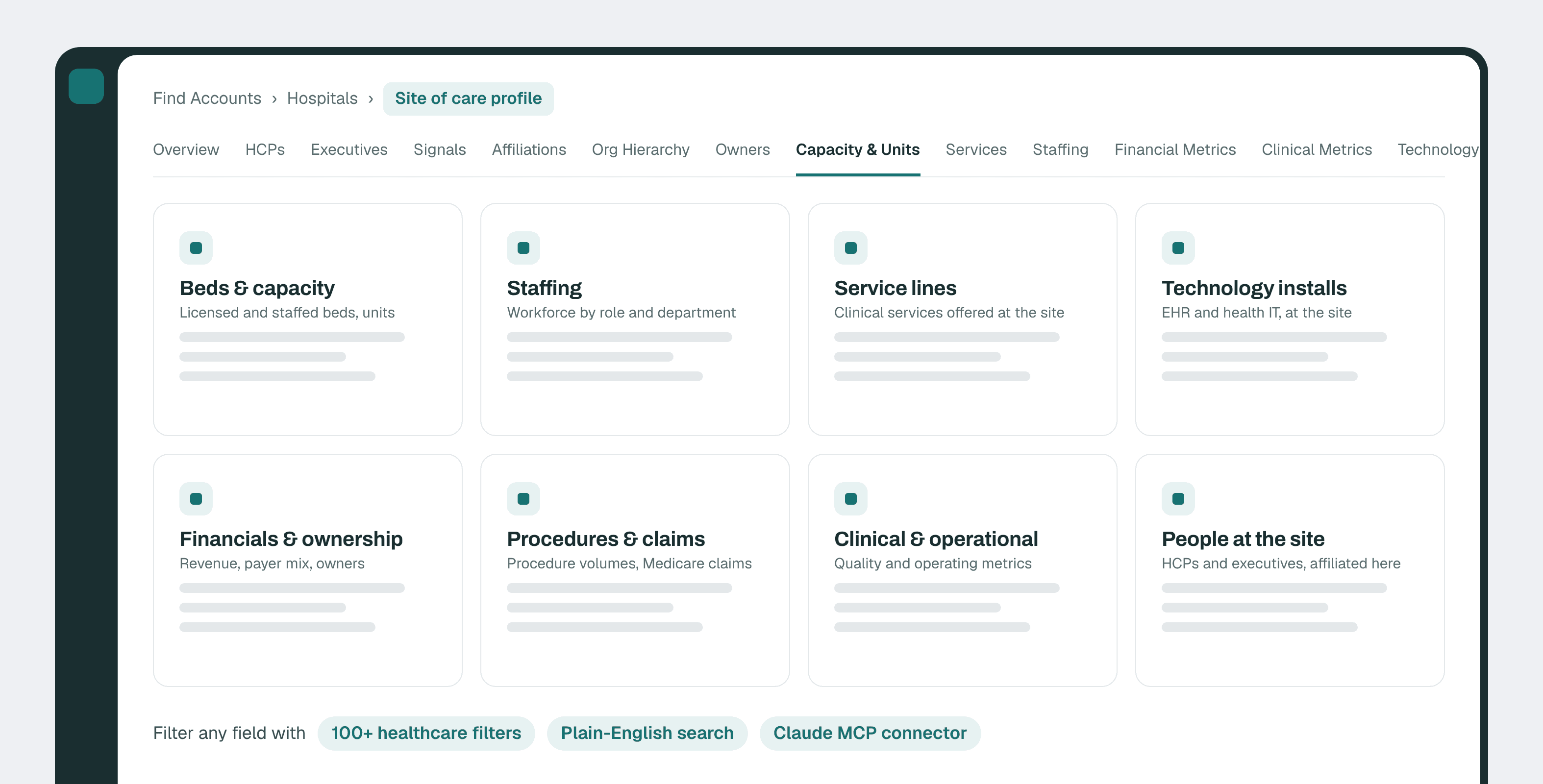
Dmand AI shows technology installs, beds, staffing, service lines, financials, procedures and Medicare claims for every site of care.
For finance, IT and procurement roles at health systems, ZoomInfo works like any B2B database. These checks matter when you sell to clinicians, departments and sites.
Is ZoomInfo worth it for healthcare sales teams?
It depends on who you sell to.
ZoomInfo fits when you:
- Sell to many industries, with healthcare as one
- Target finance, IT or procurement leaders at health systems
- Use intent data and visitor tracking across every account
Look elsewhere when you:
- Sell to clinicians, department leaders or site administrators
- Need NPIs, site affiliations, bed counts or claims
- Pay for an annual contract and still map contacts to hospitals by hand
ZoomInfo draws the same line in its own review of Definitive Healthcare. It describes its healthcare data as "company and contact data across all industries including healthcare" and sends buyers to Definitive for IDN affiliations, procedure volumes and claims.
What do healthcare users say about ZoomInfo?
Themes from public reviews by people working in healthcare:
- Mapping hospitals to the health system that owns them takes extra work (TrustRadius).
- Provider financials beyond total revenue, like net patient revenue and Medicare revenue, are missing (G2).
- Pharma teams want more data on doctors and hospitals for call planning (G2).
- Data on organizations under 100 employees is less reliable (G2).
None of these are complaints about email quality. They're about how healthcare is organized.
Best ZoomInfo alternative for healthcare sales teams: Dmand AI
Dmand AI maps the people, sites and org trees of US healthcare, then runs your outreach from the same login.
- 7.4M+
- HCPs
- 11M+
- Healthcare Executives
- 997K+
- Sites of Care
- 181K+
- Medical Groups
- 1.6K+
- Health Systems & IDNs
- 6.2K+
- Hospitals
- 290K+
- Primary and Community Care Sites
- 266K+
- Ambulatory and Specialty Care Sites
Plus 105K+ behavioral health sites, 81K+ post-acute and long-term care sites, 115K+ dental and eye care sites and 90K+ pharmacies.
Physician Network Discovery: warm paths into any health system
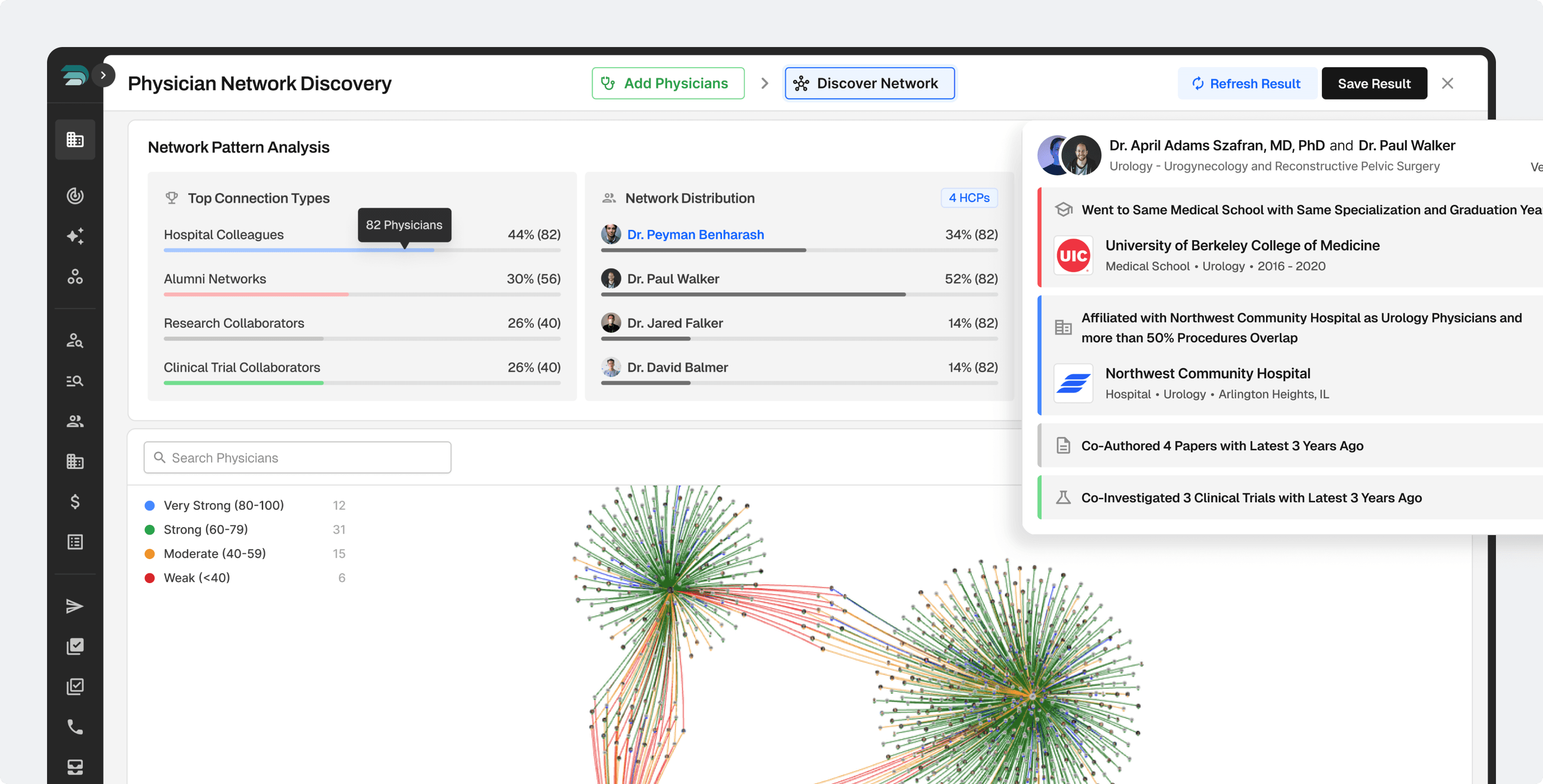
Network Discovery shows who you already know that's connected to your prospect: current coworkers, past colleagues, med school and residency classmates, co-authors and clinical trial co-investigators.
So instead of cold-emailing a CMIO, you ask a customer who trained with them for an intro. ZoomInfo doesn't list clinician relationship data among its datasets.
People at the right site, under the full IDN tree
Every HCP and executive in Dmand AI sits at the site of care where they work. Sites roll up to hospitals, medical groups and health systems.
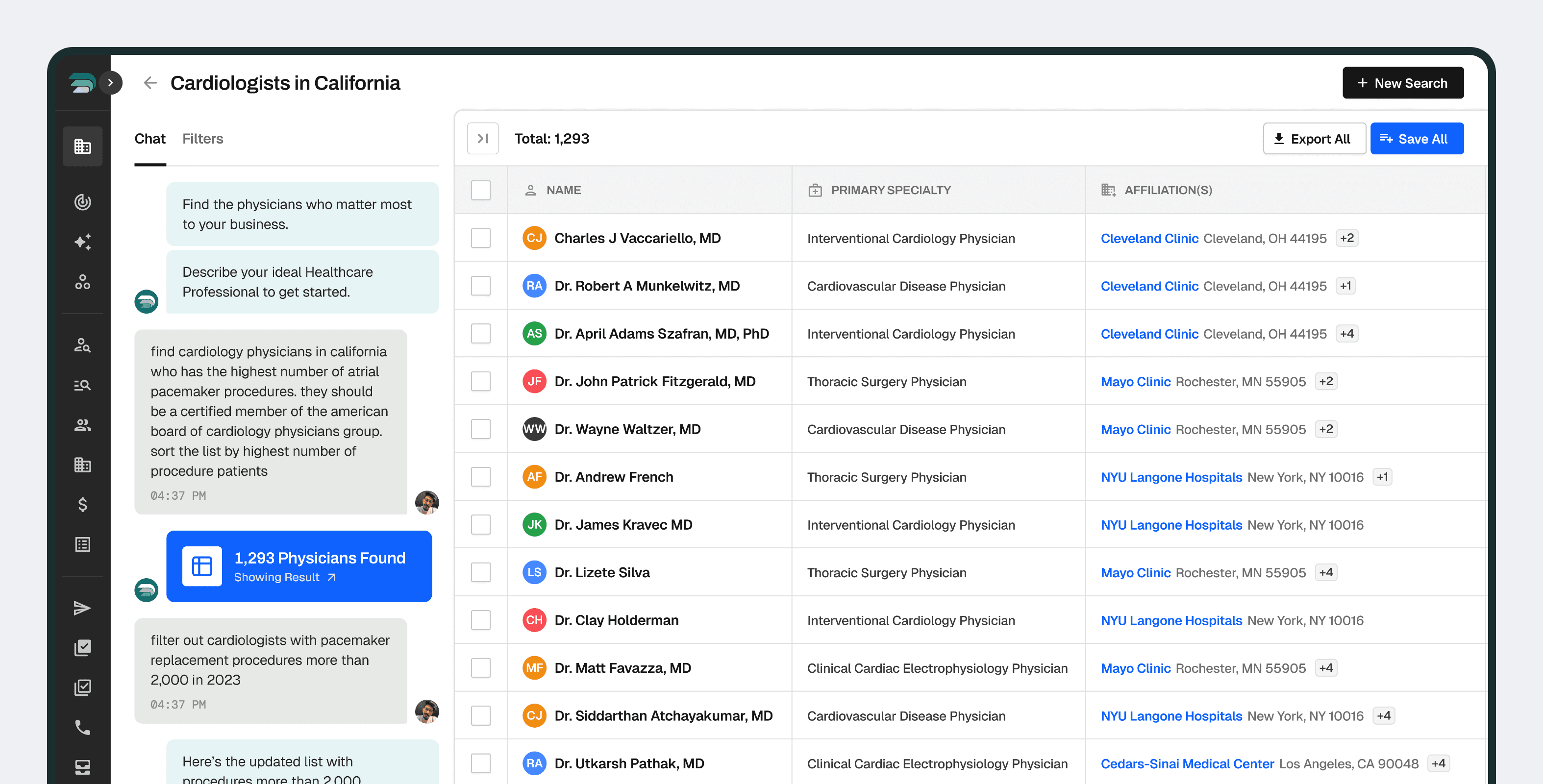
Search for cardiologists at one IDN's surgery centers and you get the cardiologists at those centers, not everyone on the system's email domain.
Beds, service lines, technology installs and financials for every site
Every site profile carries what you qualify on:
- Beds, staffing and service lines
- Technology installs, including EHR, at the site
- Financials and ownership
- Procedures and Medicare claims
- Clinical and operational metrics
Filter on any of them with 100+ healthcare filters, ask in plain English, or query through the Claude MCP connector.
“I like Dmand AI’s extremely curated and comprehensive healthcare database, which you won’t find on any other platform with this level of detail. The ability to filter by specialty, location, independent physician or not, and many others is incredibly useful. The customer support team is very responsive to feature requests and suggestions.”

Verified emails and direct dials from 20+ sources
Dmand AI runs every contact through a waterfall of 20+ data sources, one after another, until it finds a match. It validates what it finds before the contact reaches your list.
You get a professional email, a personal email and a direct dial, plus LinkedIn.
Plain-English search and the Claude MCP connector
Type "cardiologists at ASCs in Texas with a direct dial" and get a list you can filter. The Claude MCP connector runs the same search from inside Claude.
ZoomInfo has an MCP server too. The difference is what comes back: sites, affiliations and NPIs.
Outreach in the same login
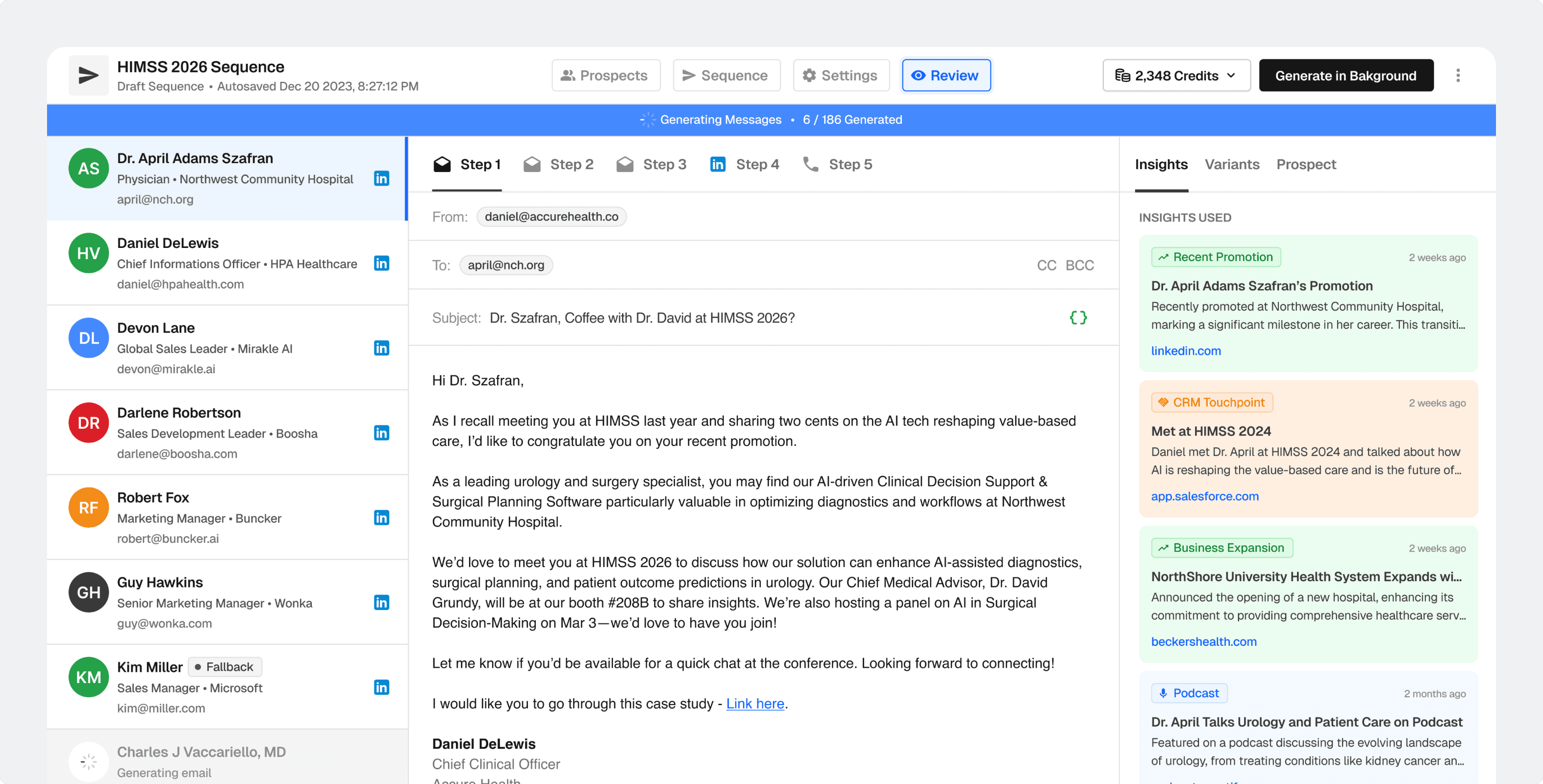
Build a list, research it and reach it without switching tools:
- AI Research Columns answer a question about every row of a list.
- Zeus AI writes a personalized email for each prospect.
- Sequences run email, an auto-dialer, LinkedIn and tasks, with one inbox for replies.
- Integrations with Salesforce, HubSpot, Slack, Google Workspace and Outlook.
NPI contact enrichment API
Send one NPI or up to 45 at a time. Get back professional emails, direct dials and, for recruiters, personal emails. You pay credits only when data is found, and replays are free for 30 days.
Read the API documentation at docs.dmand.ai.
Published pricing and a 30-day free trial
Kickstarter is $249 per user per month with 1,000 credits. Growth is $499 with 2,500 credits. Enterprise pricing starts above 10 seats. Save 10% billed half-yearly or 20% billed annually. No contract.
The 30-day trial previews the full dataset, fully searchable with trial credits. See every plan on the Dmand AI pricing page.
Run your top accounts through Dmand AI
Pick 50 hospitals or medical groups you know well. Search them free for 30 days and compare what you find with ZoomInfo.
ZoomInfo vs Dmand AI: comparison summary
Side by side on the data and tools healthcare sellers use every day.
| Dimension | ZoomInfo | Dmand AI |
|---|---|---|
| Built for | Every B2B industry | Teams selling into US healthcare |
| Healthcare dataset | None in its data catalog | HCPs, executives, sites of care and org trees |
| HCP identity | No NPI field | NPI on every HCP, 7.4M+ HCPs |
| Affiliations | One company per contact | HCPs and executives at the site of care |
| Org hierarchy | Corporate parent and subsidiary | IDN to hospital to department to site |
| Beds, staffing and service lines | Not listed | Every site of care |
| Technology installs | By company | By site of care |
| Claims and procedures | Not listed | Medicare claims and procedure volumes |
| Contact data | 500M+ profiles across all industries | 7.4M+ HCPs and 11M+ healthcare executives |
| Intent data and buying signals | 4,500+ intent topics | 80+ healthcare buying signals |
| Relationship intelligence (warm introductions) | Not listed | Physician Network Discovery |
| Sales engagement (sequences, dialer, inbox) | Offered; features vary by contract | Sequences, auto-dialer, LinkedIn and inbox in every plan |
| AI search and MCP | AI agents in GTM Workspace; MCP server | Plain-English search; Claude MCP connector |
| Contact enrichment API | API and MCP | NPI enrichment API, up to 45 NPIs per call |
| Pricing | Custom quote; median $33,500 a year (Vendr) | $249 or $499 per user per month |
| Free trial | 7 days, plus the free Lite tier | 30 days, full dataset preview |
| Contract | Annual, often auto-renewing (Vendr) | No contract |
| Coverage outside the US | Global | US only |
ZoomInfo vs Definitive Healthcare vs Dmand AI
Healthcare teams often shortlist all three. Read our full Definitive Healthcare review for the details.
| Dimension | ZoomInfo | Definitive Healthcare | Dmand AI |
|---|---|---|---|
| Built for | Every B2B industry | Healthcare market intelligence | Healthcare sales and outreach |
| Provider data | No healthcare dataset | 9,000+ hospitals and IDNs, 3M+ physicians, nurses and allied professionals, 130,000+ physician groups | 7.4M+ HCPs, 997K+ sites of care, 181K+ medical groups |
| Affiliations | One company per contact | Primary, current and historical affiliations | Site-level, under the IDN tree |
| Claims | Not listed | All-payor medical and prescription claims | Medicare claims |
| Intent and buying signals | 4,500+ topics | Not offered | 80+ healthcare signals |
| Relationship intelligence | Not listed | Not offered | Physician Network Discovery |
| Sales engagement | Offered | Not offered | Included |
| Logins | One platform | Four product logins | One login |
| Pricing | Median $33,500 a year (Vendr) | $25,000 to $60,000 a year for 1 to 5 users (Vendr) | $249 or $499 per user per month |
| Free trial | 7 days | Request form, terms not published | 30 days |
ZoomInfo competitors for healthcare sales, and who each is for
Six tools buyers compare with ZoomInfo when they sell into healthcare.
| Alternative | Best for |
|---|---|
| Dmand AI | Teams selling into US hospitals, health systems and medical groups that need site-level people data, warm intros and outreach in one login |
| Definitive Healthcare | Life sciences, MedTech and consulting teams that need all-payor claims, market sizing and expert data |
| IQVIA | Pharma and life sciences commercial teams that need reference data and analytics |
| Apollo.io | Teams selling across industries that want a free tier, published pricing and built-in sequences |
| Cognism | Teams whose buyers sit mostly in Europe; Vendr places its strongest coverage in EMEA |
| Lusha | Individual reps who want quick, self-serve contact lookups |
Who switches from ZoomInfo to Dmand AI
Health IT and Services Vendors
EHR, revenue cycle and IT services vendors sell to hospital IT and operations leaders. Dmand AI shows which systems each site runs and who leads IT there.
Healthtech and Digital Health
Digital health companies sell to service line leaders and the clinicians who use their product. Network Discovery finds a warm path to those leaders.
Medical Staffing and Recruiting
Recruiters need clinicians and the hiring managers at each facility. NPI enrichment returns personal emails for recruiting, and site profiles show beds, staffing and service lines.
Consulting firms and agencies serving healthcare
Consultants map a health system before every pitch. Org trees, financials and service lines by site replace hours of manual research.
MedTech and Medical Supplies
MedTech teams sell to surgeons and supply chain leaders at hospitals and surgery centers. Procedures, volumes and Medicare claims by site show where the cases happen.
Pharma, Biotech and CROs
Commercial and medical affairs teams get HCP profiles with prescriptions, trials, publications and open payments, tied to the sites where those HCPs practice.
Still on a ZoomInfo contract? Test Dmand AI before you renew
Renewal is your best window to switch. Vendr reports ZoomInfo notice periods of 30 to 90 days, so start early.
Find your notice date.
Check your order form for the term, the renewal clause and the last day to give notice.
Pick 50 target accounts.
Use real hospitals, health systems or medical groups from your pipeline.
Search them in a Dmand AI trial.
The 30-day trial previews the full dataset, fully searchable with trial credits.
Compare side by side.
Count matched sites, HCPs with an NPI, executives at each site, and verified emails and direct dials.
Move your outreach.
Connect Salesforce or HubSpot, rebuild your sequences and set up mailboxes before the ZoomInfo term ends.
Take the six contract questions above to your ZoomInfo renewal call.
ZoomInfo or Dmand AI: which should you choose?
Choose ZoomInfo if healthcare is one of many industries you sell to, your buyers work in finance, IT or procurement, and you want intent data across every account.
Choose Dmand AI if you sell into US hospitals, health systems, medical groups and clinics, and you need the right people at the right site, warm intros and outreach in one login with no contract.
ZoomInfo maps companies. Dmand AI maps sites of care and the people in them.