

Short Answer
Apollo.io is a sales platform built for every B2B industry. It pairs a 240M-contact database with sequences, a dialer and AI tools, with a free plan and paid plans from $49 per user a month. Apollo markets doctor and nurse databases, but its search filters are the same for every industry: job title, seniority, location, company and keywords. There is no NPI, specialty or facility-type filter, and no link from a clinician to the hospital or health system they work for. Dmand AI is built only for US healthcare: 7.4M+ HCPs keyed by NPI, 11M+ executives tied to the site they run, and warm paths through Physician Network Discovery, from $249 per user per month with a 30-day free trial.
| Apollo.io fits if you | Dmand AI fits if you |
|---|---|
| Sell to many industries and healthcare is a small slice | Sell only into US hospitals, health systems, practices or sites of care |
| Need a free plan or the lowest price per seat | Need every HCP tied to an NPI and to the sites they practice at |
| Target corporate titles you can find by company and title | Need the buying committee at one hospital or clinic, not the whole system |
| Already run sequences in Apollo and need healthcare contacts only now and then | Want a warm introduction into an account through people you already know |
Key Takeaways
- Apollo.io lists a free plan, Basic at $49 and Professional at $79 per user per month billed annually. Vendr puts the median deal at $19,000 a year.
- Apollo markets doctor, nurse and pharmacist databases, but its search has no NPI, specialty or facility-type filter. A search for doctors is a job-title or keyword match.
- Apollo's own hospital guide tells reps to check by hand whether a hospital belongs to a health system or was recently acquired.
- In TrustRadius's summary of 89 recent Apollo reviews, 34% raise contact data accuracy and completeness. This guide gives a fix for bouncing emails, missing direct dials and doctors filed under the wrong hospital.
- Dmand AI covers 7.4M+ HCPs by NPI, 11M+ healthcare executives and 997K+ sites of care, each placed in an org hierarchy from IDN to site.
- Dmand AI costs more per seat, at $249 per user per month, and adds Physician Network Discovery, healthcare profile data and 80+ healthcare buying signals.
What is Apollo.io?
Apollo.io is a B2B sales platform founded in 2015. It sells to companies in every industry. Its story page says it passed $150M in annual recurring revenue in May 2025 and lists Matt Curl as CEO.
Apollo puts a contact database, email sequences, a parallel dialer, deal tracking and AI agents in one workspace. Its pricing page says more than 600,000 companies use it.
Apollo.io data: 240M contacts and 30M companies across every industry
Apollo lists 240M contacts and 30M companies, searchable with 65+ filters. It says the data comes from a proprietary data contributor network and claims 98% email accuracy in its hospital prospecting guide.
The database is horizontal. A hospital, a software company and a retailer sit in the same company model with the same fields.
| Apollo.io lists | Not in Apollo's search filters |
|---|---|
| 240M contacts with emails and phone numbers | NPI, specialty or facility type as a filter |
| 30M companies with firmographic and technographic data | A hierarchy from IDN to health system, hospital and site of care |
| Job title, seniority, location, company size, revenue and technology filters | Which sites a physician practices at, primary and secondary |
| Sequences, parallel dialer, buying intent, MCP and API | Procedures, Medicare claims, beds or service lines |
Apollo.io for healthcare: what its doctor and nurse pages say vs what its search does
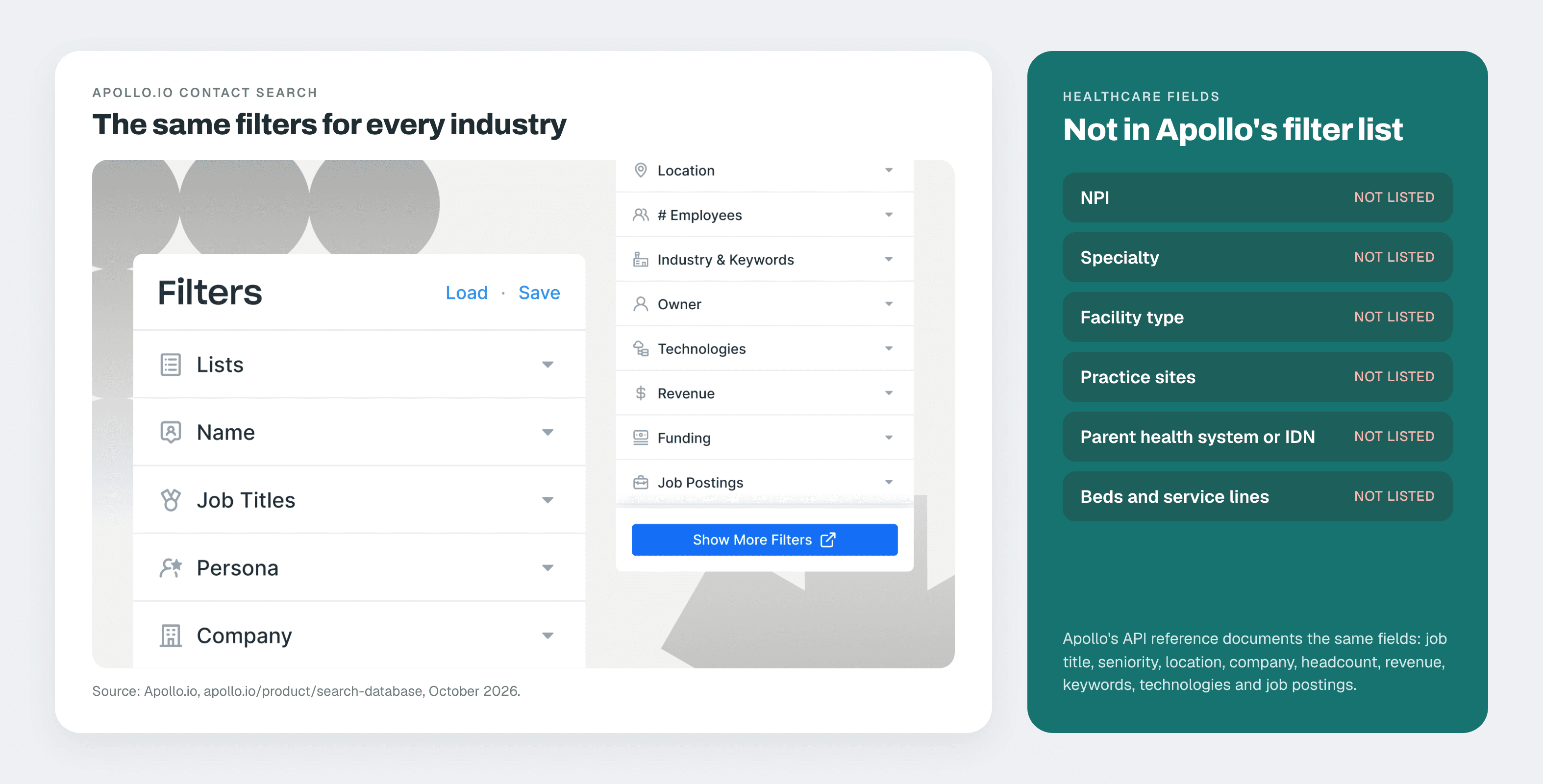
Apollo runs a healthcare providers page for private practices, urgent care centers and multi-specialty groups. It also has landing pages for doctors, physicians, nurses, nurse practitioners, physician assistants and pharmacists. They say you can find contacts by specialty, facility type and location.
Apollo's search works differently. Its contact search and its People Search API reference list the same filters for every industry: job title, seniority, location, company, headcount, revenue, industry keywords, technologies and job postings.
None of those is a healthcare field. There is no specialty, NPI or facility-type filter, so a search for doctors is a match on job titles or keywords.
| What a healthcare seller needs | What Apollo's healthcare pages say | What Apollo's search filters on |
|---|---|---|
| Doctors by specialty | Find doctors by specialty | Job title or keyword match; no specialty filter |
| Sites by type (hospital, ASC, clinic) | Find contacts by facility type | Company keywords and headcount; no facility-type filter |
| Clinicians where they practice | Find contacts by region | Where the person lives, or the employer's headquarters |
| Clinicians by NPI | Not mentioned | No NPI filter or field |
| Contact counts by role | Not published | Not published |
Apollo.io products: data, sequences, dialer, MCP and API explained
Apollo sells one workspace with several layers. These are the parts healthcare sellers ask about most.
Apollo Data and Waterfall Enrichment
Apollo Data is the 240M-contact database. Waterfall Enrichment adds coverage by checking other data providers for a record. An email lookup costs at most 1 credit per contact, and Apollo charges only for emails it can verify.
Apollo sequences and Parallel Dialer
Sequences run email, calls and tasks in one cadence. The Parallel Dialer calls several numbers at once. Email campaigns come with every plan, and free plans connect Gmail accounts only.
Apollo MCP for Claude, ChatGPT and Perplexity
Apollo MCP lets reps search, enrich and sequence prospects inside Claude, ChatGPT or Perplexity. Apollo says any plan qualifies, including free, with no separate subscription.
Apollo API
The Apollo API is charged on consumption, and access depends on your plan. Apollo's pricing FAQ puts API access for advanced or custom integrations on Custom plans.
Common Apollo.io problems for healthcare sales teams, and how to fix them
These are the problems healthcare sellers raise most in Apollo.io reviews and in Apollo's own healthcare guidance. Each answer covers why it happens, what you can do inside Apollo, and how Dmand AI handles it.
Apollo.io emails bouncing for hospital and clinic contacts: causes and fixes
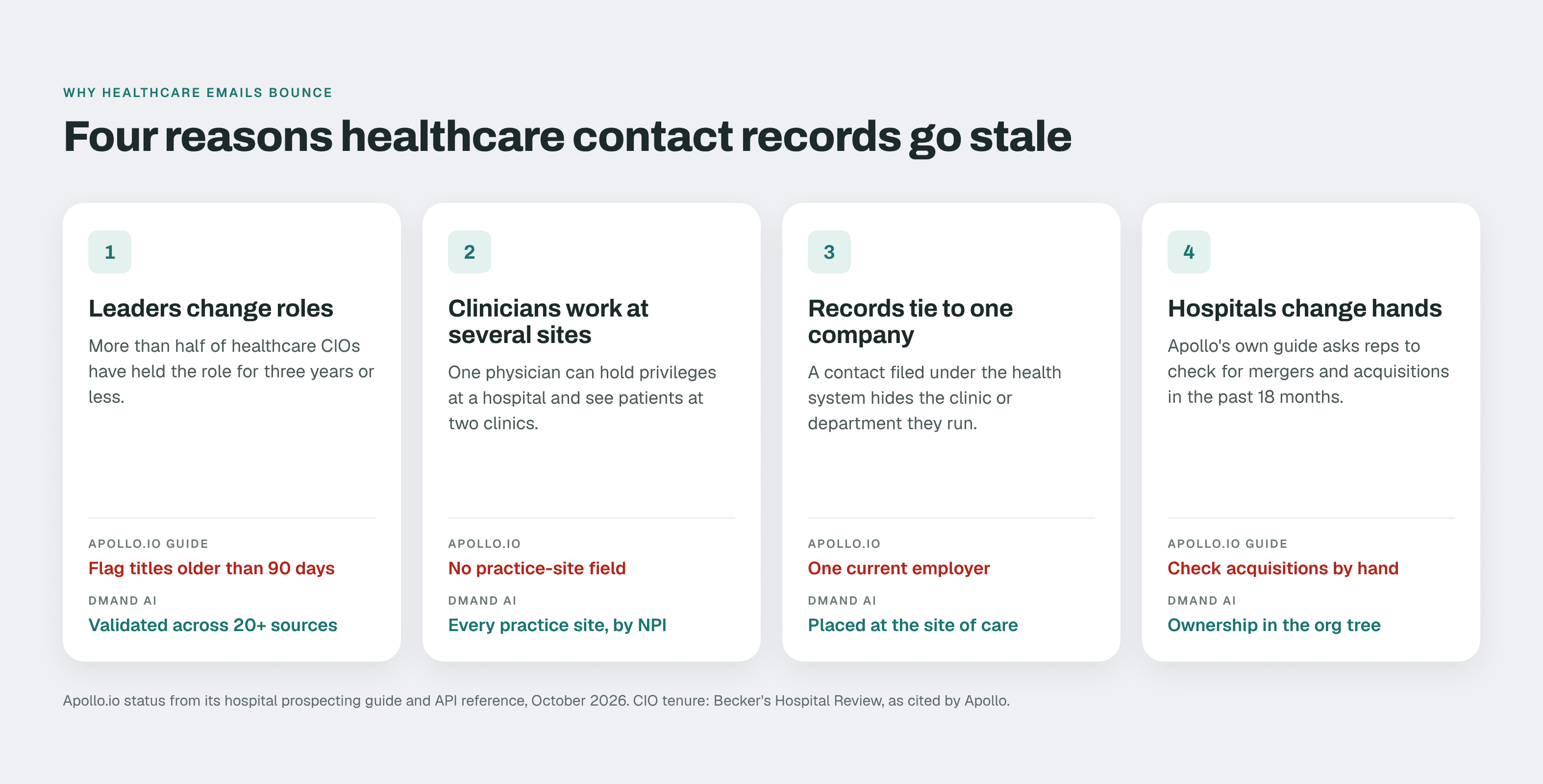
Why it happens. Accuracy and deliverability are the most common complaints in Apollo reviews. TrustRadius's summary of 89 verified reviews from the past 18 months says 34% raise contact data accuracy and completeness. Healthcare adds two problems. Leaders change roles often: Apollo's own hospital guide cites Becker's Hospital Review data showing more than half of healthcare CIOs have held their role for three years or less. And clinicians work across several sites, so a record tied to one company can point to an inbox they no longer check.
Fix it in Apollo.
- Re-verify emails right before a sequence goes out, not at export.
- Flag contacts with no title update in 90 days, as Apollo's guide suggests.
- Confirm a physician's current practice location in the free NPI Registry before you send.
How Dmand AI handles it. Contacts come from a waterfall of 20+ sources and are validated before they reach your list. Every HCP is tied by NPI to each site where they practice, so a move from one site doesn't leave you with only an old inbox.
Test it on accounts you know. Pull 50 hospitals or practices you already sell to in both tools. Count correct sites, titles, emails and direct dials. A reviewer sample cannot tell you how either tool performs on your territory.
Apollo.io showing the wrong hospital or health system for a doctor: how to check
Why it happens. Apollo links each contact to one current employer. Apollo's API reference says its location filter uses where the person lives or where the employer is headquartered. Healthcare organizations nest: a clinic sits under a hospital, which sits under a health system and an IDN. Apollo's guide to finding hospital decision-makers tells reps to confirm three things by hand before prioritizing an account:
- Is the facility part of a larger health system, or independent?
- Was it acquired or merged in the past 18 months?
- Does the parent system run centralized IT and clinical governance?
Fix it in Apollo. Check the hospital's own website for its parent system, and match the physician's practice addresses in the NPI Registry against the account.
How Dmand AI handles it. Every site of care sits in a tree from site to hospital, health system and IDN, with HCPs and executives attached to the site where they work.
| What you need to know | Apollo.io | Dmand AI |
|---|---|---|
| Does this hospital belong to a health system? | Confirm by hand, per Apollo's guide | Shown in the hierarchy, from IDN to site of care |
| Which sites does this physician practice at? | No practice-site field; one current employer | Every site and group, primary and secondary |
| Who runs this clinic, not the parent system? | Title search; location is home or headquarters | Executives affiliated at the site level |
| How many hospitals sit under this system? | Not listed | 1.6K+ health systems and IDNs mapped above 6.2K+ hospitals |
Apollo.io missing direct dials for physicians and nurse leaders: where to look
Why it happens. Apollo's healthcare pages say most records include a verified email and a direct phone number, which means some do not. Missing and outdated phone numbers come up repeatedly in TrustRadius reviews.
Fix it in Apollo. Run Waterfall Enrichment on the records that matter, knowing each verified number costs credits. For practices, the NPI Registry lists a practice location phone number that reaches the front desk.
How Dmand AI handles it. Direct dials come from the same 20+ source waterfall. The NPI API also returns a direct dial from a Type 1 NPI, and you pay credits only when it finds one.
Apollo.io search for nurses, practice managers and clinic administrators
Why it happens. Apollo's nurse pages promise search by specialty and facility type, but its search filters are job title, seniority, location and company fields. Seniority options run from owner and C-suite to manager and entry level, with no clinical roles. Site-level roles depend on how each contact's employer is recorded, and Apollo publishes no counts.
Fix it in Apollo. Search title variants together: Director of Nursing, Nurse Manager, Chief Nursing Officer, Practice Administrator and Clinic Manager. Then check each contact's location against the site you are targeting.
How Dmand AI handles it. Dmand AI covers 961K+ nurses (RN, LPN and APRN) and places administrators and directors of nursing at the facility they run, so you can open a site and see who works there.
Can you search Apollo.io by NPI or specialty? No, only by job title
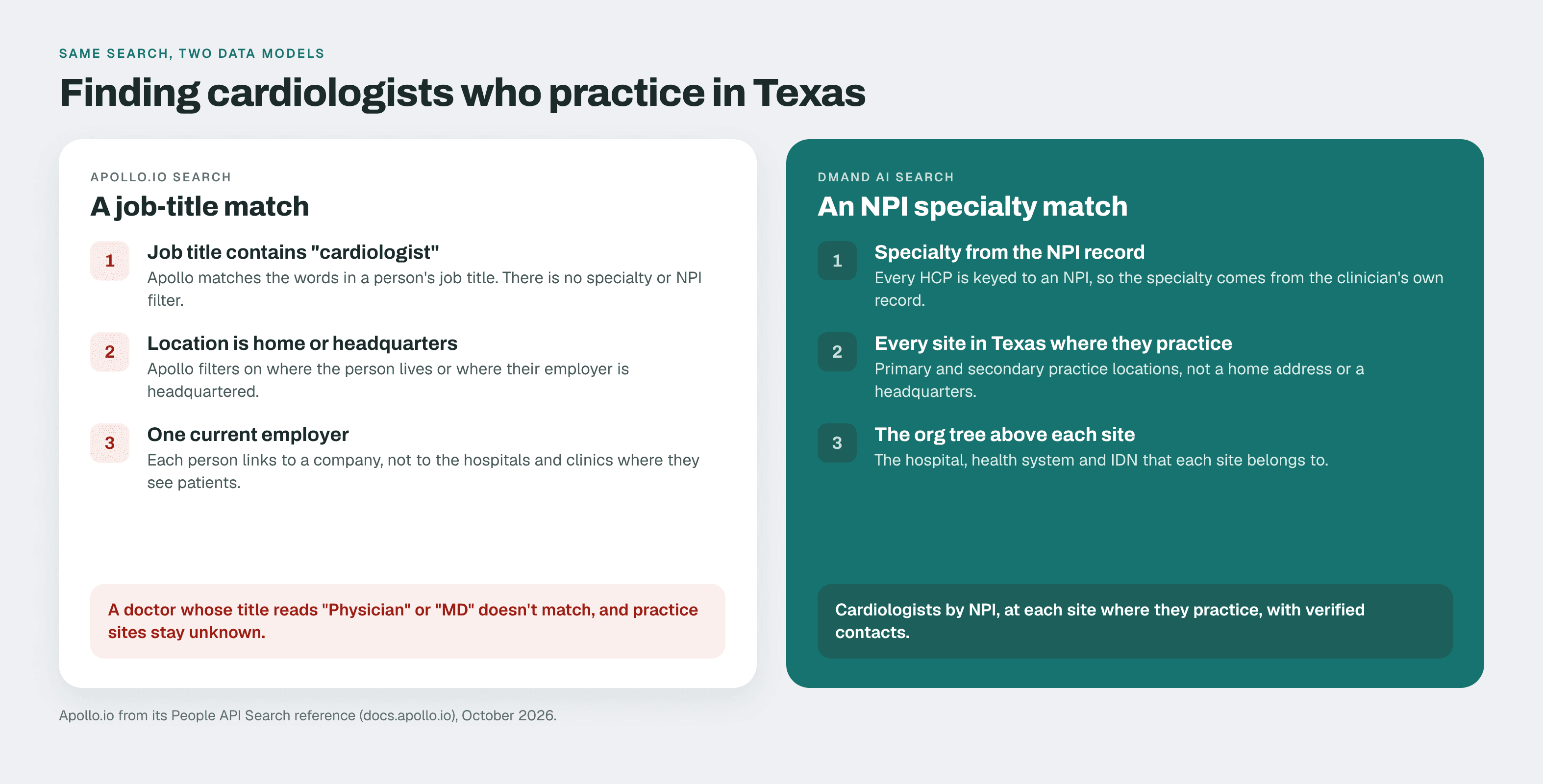
Why it happens. NPI is how healthcare sellers match a clinician to CMS data, to a CRM record and to every site they bill from. Apollo's search has no NPI filter, and its People Search API takes no NPI field. It has no procedure or patient volume data either. A search for a specialty is a match on the words in a job title.
Fix it in Apollo. Look up NPIs separately in the NPI Registry and match them to Apollo records by name and address before you import to your CRM.
How Dmand AI handles it. Every HCP is keyed to a unique NPI: 1.3M+ physicians (MD and DO), 961K+ nurses, 228K+ physician assistants and 335K+ pharmacists within 7.4M+ HCPs. Profiles add procedures and patient volumes, and you can filter on both.
Apollo.io credits after a bounced email: what to ask
Why it happens. Apollo says it charges only for emails it can verify. Its pricing and credits pages do not say whether credits come back when a verified email later bounces. Credits also expire at the end of each cycle, and add-on credits renew until you remove them.
Fix it in Apollo. Ask in writing how bounced verified emails are handled before you buy add-on credits, and set per-user credit caps in Apollo's team settings.
How Dmand AI handles it. The NPI enrichment API charges credits only when it finds data, and repeat lookups of the same NPI are free for 30 days.
Apollo.io annual plan: can you cancel or downgrade mid-term?
No. Apollo's pricing FAQ says annual plans cannot be downgraded mid-cycle, and moving from annual to monthly means canceling and waiting for the term to end. Other terms to know:
- Cancellations take effect at the end of the plan term.
- Downgrades take effect immediately, with no refund for unused time.
- Every seat on an account must be on the same plan.
- API access for custom integrations sits on Custom plans.
How Dmand AI handles it. No contract. Half-yearly billing saves 10% and annual billing saves 20%.
Apollo.io healthcare buying signals: EHR migrations, mergers and new executives
What Apollo offers. Buying intent and job change alerts. Its hospital guide still tells reps to watch healthcare triggers themselves: new executive appointments, EHR migrations, AI governance committees and mergers.
Fix it in Apollo. Set news alerts on your top health systems and log each trigger on the account.
How Dmand AI handles it. 80+ pre-built healthcare buying signals sit on the same records you search and sequence.
Search 50 accounts you already know
Start the 30-day trial and look up the hospitals and practices you work today. Check the parent system, the NPI and the people at each site. No card, no call.
Top Apollo.io alternative for healthcare sales teams: Dmand AI
Dmand AI is the healthcare sales intelligence and outbound platform for teams selling into US healthcare. Its data model is built only for healthcare: health systems, hospitals, medical groups and sites of care in a parent-child tree, with HCPs and executives attached to the site where they work. Search, enrichment and multi-channel sequences run on the same records.
- 7.4M+
- HCPs
- 1.3M+
- Physicians (MD and DO)
- 961K+
- Nurses
- 11M+
- Healthcare Executives
- 997K+
- Sites of Care
- 1.6K+
- Health Systems & IDNs
- 6.2K+
- Hospitals
- 181K+
- Medical Groups
Also mapped: 235K+ solo practices, 12K+ urgent care centers, 11K+ ambulatory surgery centers and 18K+ FQHCs.
Physician Network Discovery: warm introductions through people you already know
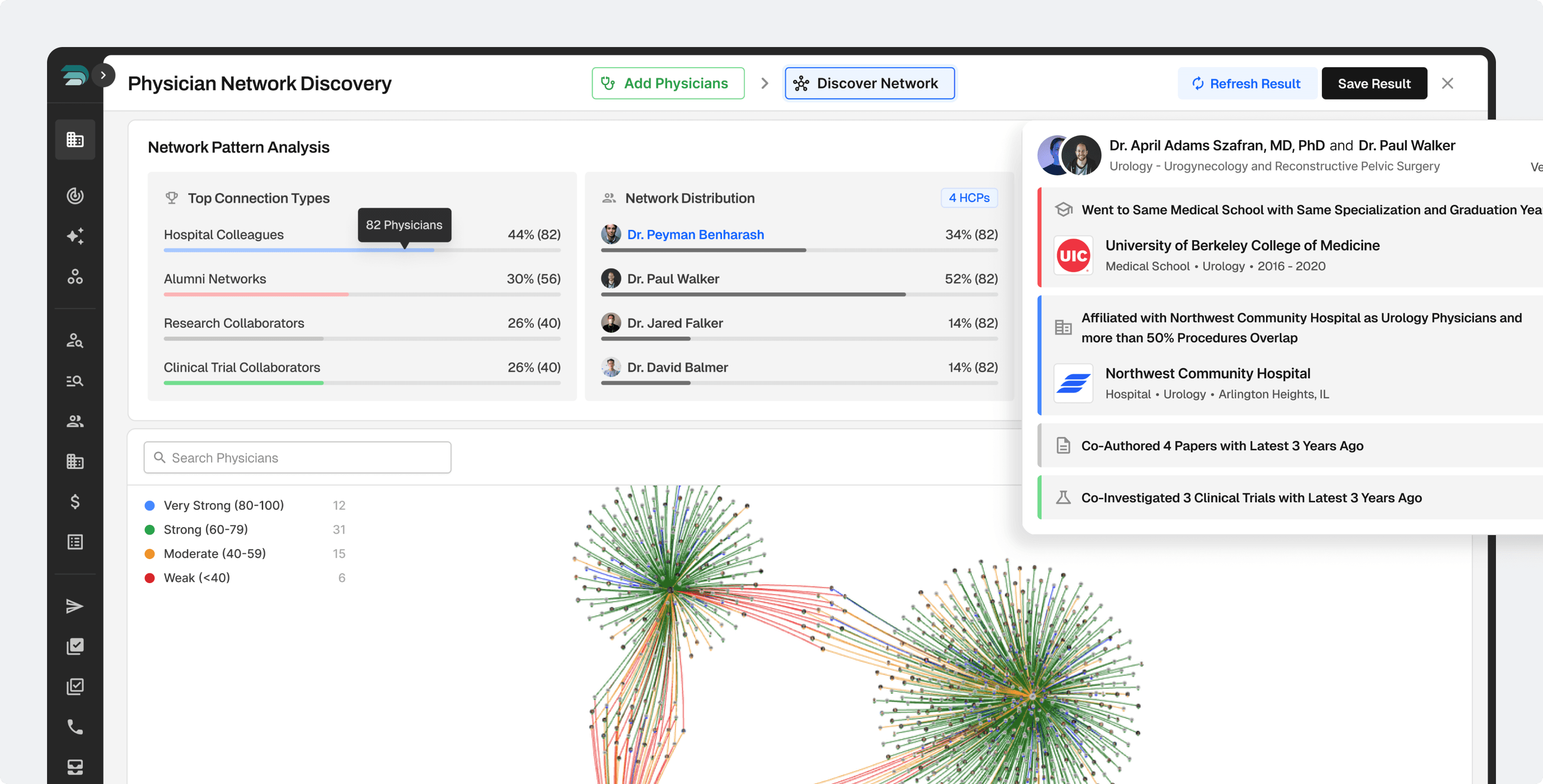
Apollo finds the person. Dmand AI also shows who already knows them. Physician Network Discovery maps the paths between people you know, such as customers, advisors or clinicians on your team, and the person you want to reach.
It checks five path types: current coworkers, past colleagues, shared training at medical school, residency or fellowship, co-authored publications, and clinical trial co-investigators. You can ask for an introduction instead of sending a cold email. Apollo does not list relationship intelligence of this kind.
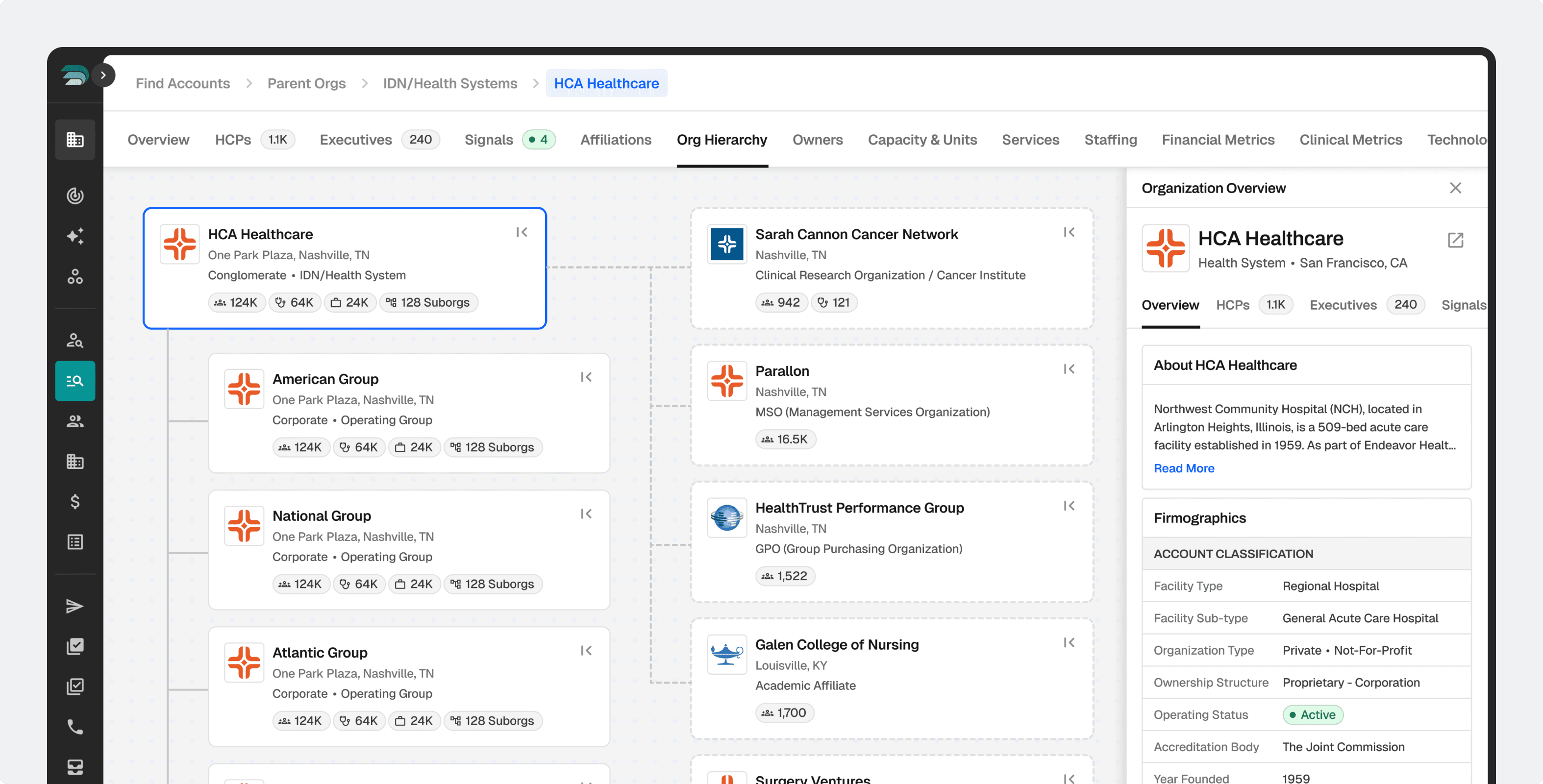
Site-level affiliation: every HCP and executive tied to a site of care
In a horizontal database, a person belongs to a company. In healthcare that company might be a 40-hospital system, while the nurse manager you need works at one outpatient clinic inside it.
Dmand AI builds the tree from the top down:
- The IDN or health system as the parent
- Hospitals, medical groups and operating orgs below it
- Departments, outpatient sites and clinics below those
- HCPs and executives at the site where they work, with primary and secondary locations
So a search for one system's surgery centers returns the people at those centers. Dmand AI maps 1.6K+ health systems and IDNs to 6.2K+ hospitals and 22K+ hospital outpatient departments, clinics and inpatient units.
7.4M+ HCPs keyed by NPI, with contacts from 20+ sources
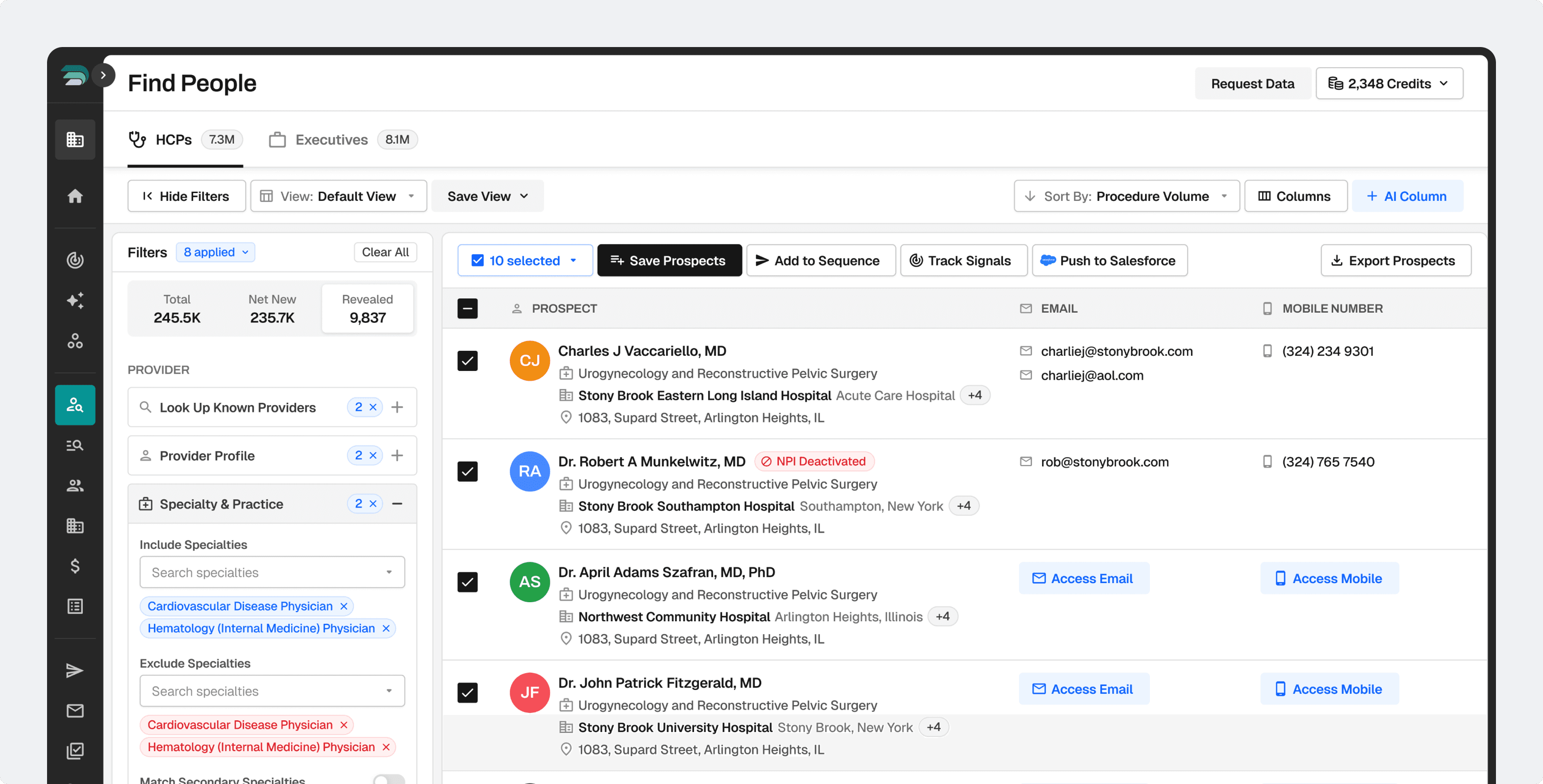
Dmand AI ties every HCP to an NPI and affiliates them to the hospitals, clinics and medical groups where they practice.
Waterfall enrichment then checks 20+ sources, one after another, for a professional email, a personal email, a direct dial and LinkedIn. Each result is validated before it reaches your list.
On healthcare contacts, Dmand AI's coverage is 2x that of Apollo and ZoomInfo, with better accuracy.
“I like Dmand AI’s extremely curated and comprehensive healthcare database, which you won’t find on any other platform with this level of detail. The ability to filter by specialty, location, independent physician or not, and many others is incredibly useful. The customer support team is very responsive to feature requests and suggestions.”

Healthcare profile data Apollo does not list: procedures, Medicare claims, beds and service lines
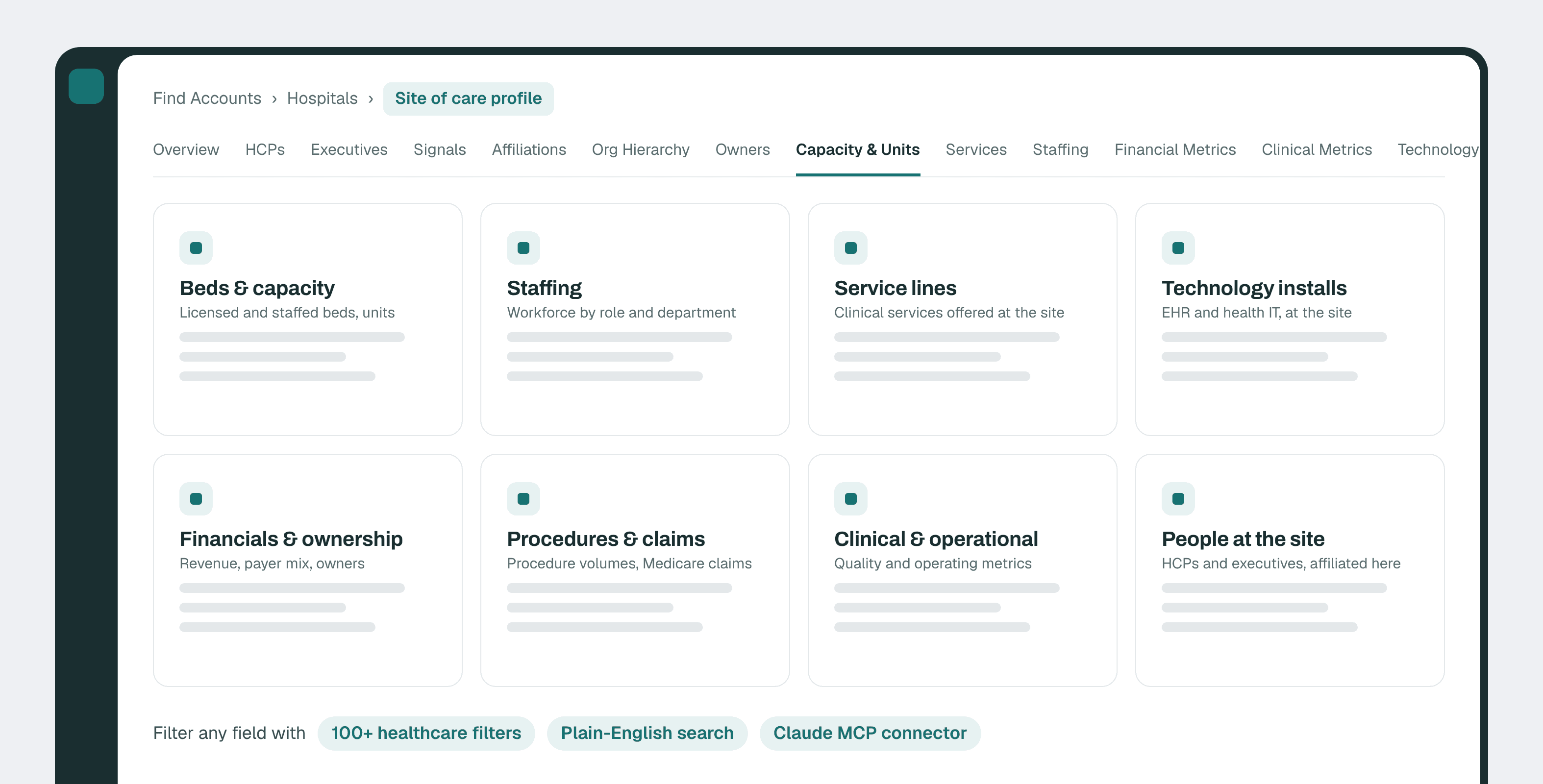
Each HCP profile shows procedures and patient volumes, clinical trials, publications, training, work history, boards, open payments and prescriptions. Each site shows its hierarchy, service lines, beds, staffing, EHR and technology installs, and financials. Claims data covers Medicare filings.
Filter on any of it with 100+ healthcare filters or in plain English. 80+ pre-built healthcare buying signals flag the accounts worth a call this week.
Dmand AI NPI enrichment API: send NPIs, get verified contacts back
Send one Type 1 NPI or up to 45 in a single request. Get back a professional email, a personal email for HCP recruiting, or a direct dial. Results arrive by webhook or polling, you pay credits only when data is found, and repeat lookups are free for 30 days.
Use it to keep the HCP records in your CRM or recruiting database current for your own team's outreach. Enriched contacts can't be resold or built into a product you sell.
Read the API documentation at docs.dmand.ai.
How a healthcare seller works in Dmand AI: search, research, then reach out
Say you sell clinical software to hospitals and want meetings booked before a big conference. Here is how that week runs in Dmand AI, in three steps and one login.
Step 1: Dmand AI natural language search builds the list in plain English
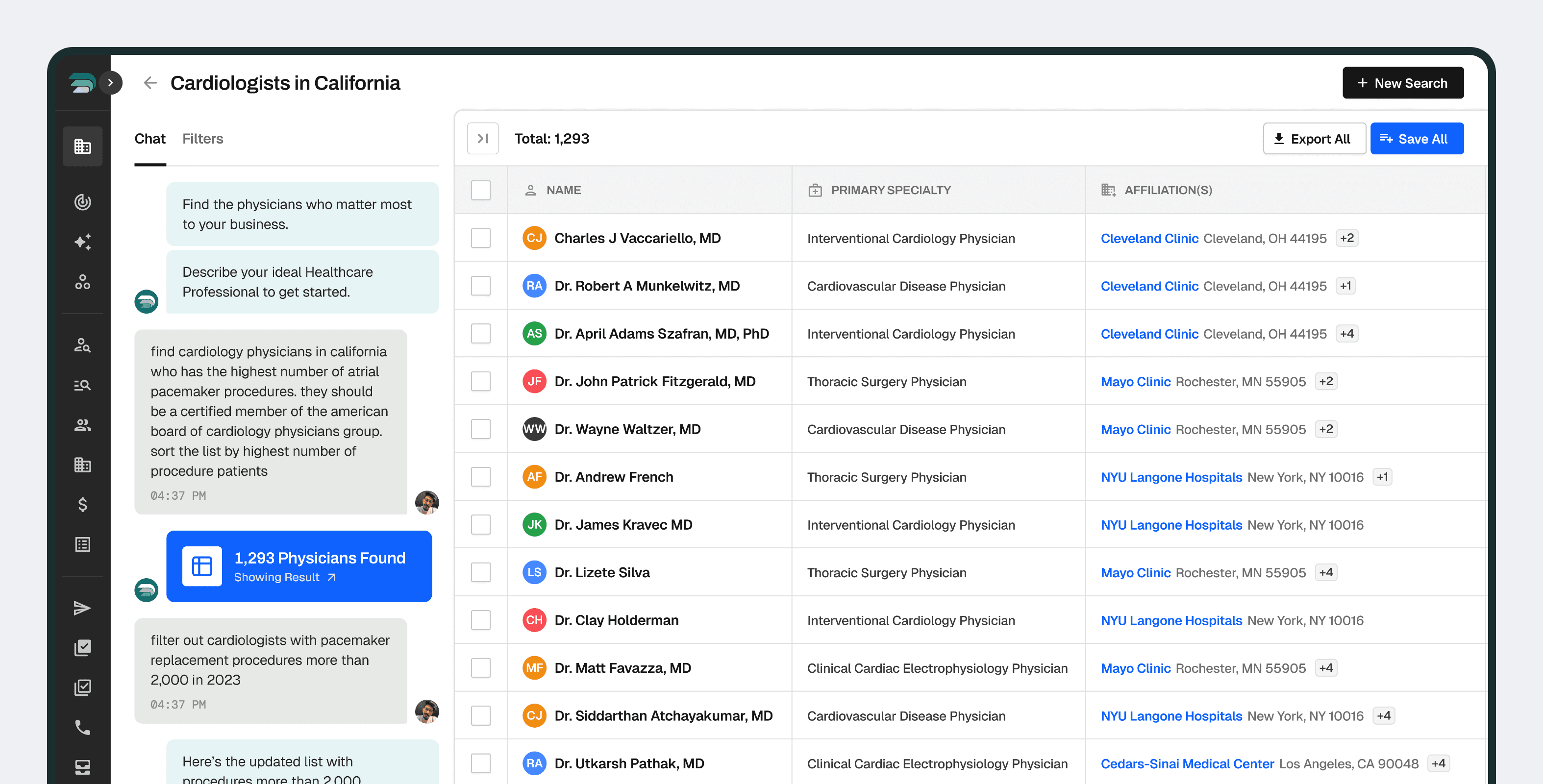
Type who you want the way you'd say it to a colleague: "cardiologists in California with the most atrial pacemaker procedures, board certified, sorted by procedure volume."
Dmand AI turns that into healthcare filters and returns the physicians, each with the hospitals they're affiliated with. Narrow it in the same chat, for example to cardiologists with more than 2,000 pacemaker procedures in 2023, then save the list. The same search runs inside Claude through the Dmand AI MCP connector.
In Apollo, the same request is a job-title match with no procedure data behind it.
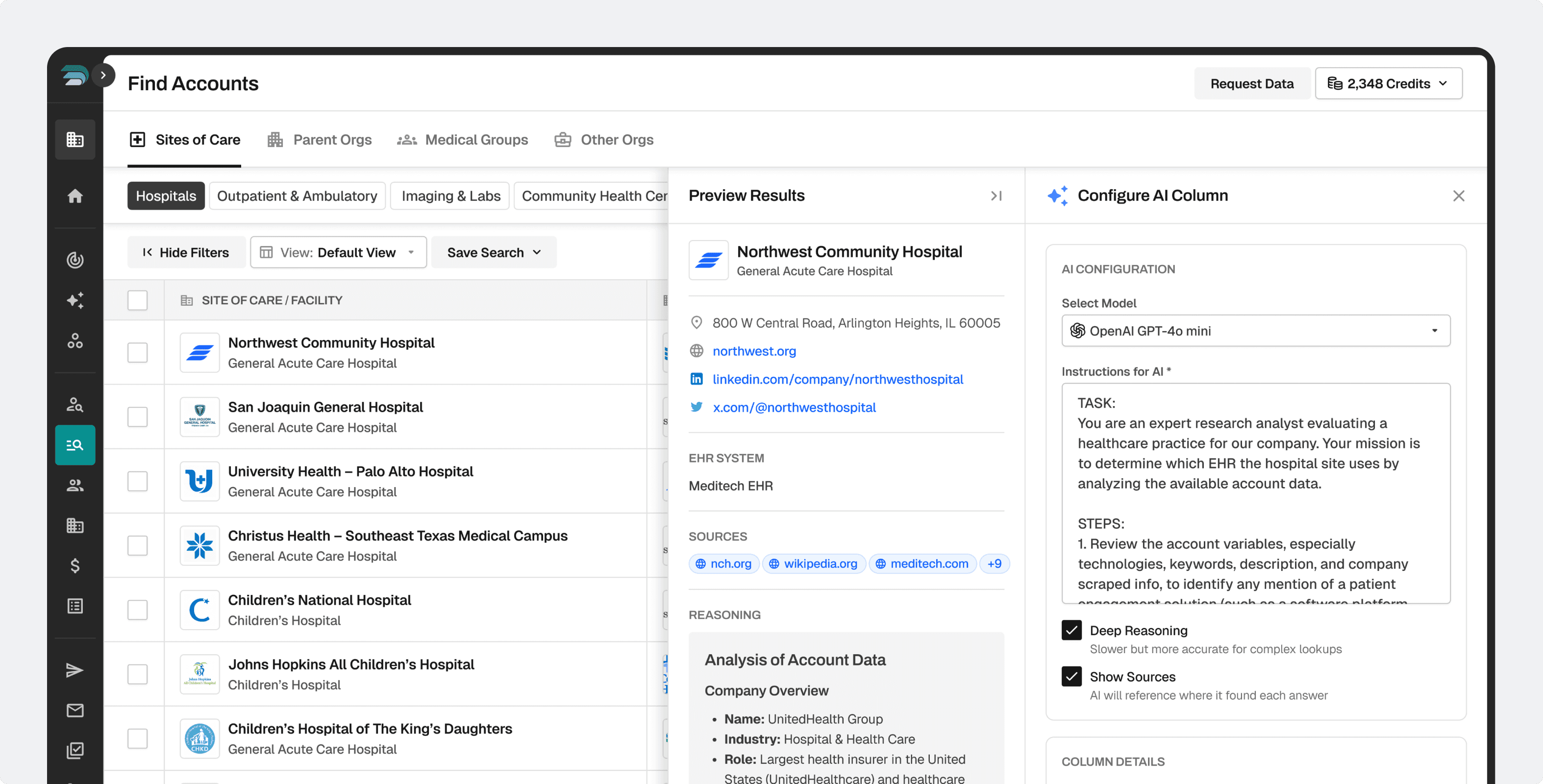
Step 2: AI Research Columns answer one question for every account on the list
Next, qualify the hospitals behind that list. Add an AI Research Column, write the question once, such as "Which EHR does this hospital site use?", and Dmand AI researches every row.
Each answer comes with its sources and reasoning, so you can check it before you rely on it. Turn on deep reasoning for harder lookups. One column replaces an afternoon of opening tabs, and it works for any question your qualification depends on.
Step 3: Zeus AI writes a personalized email for every prospect and runs the sequence
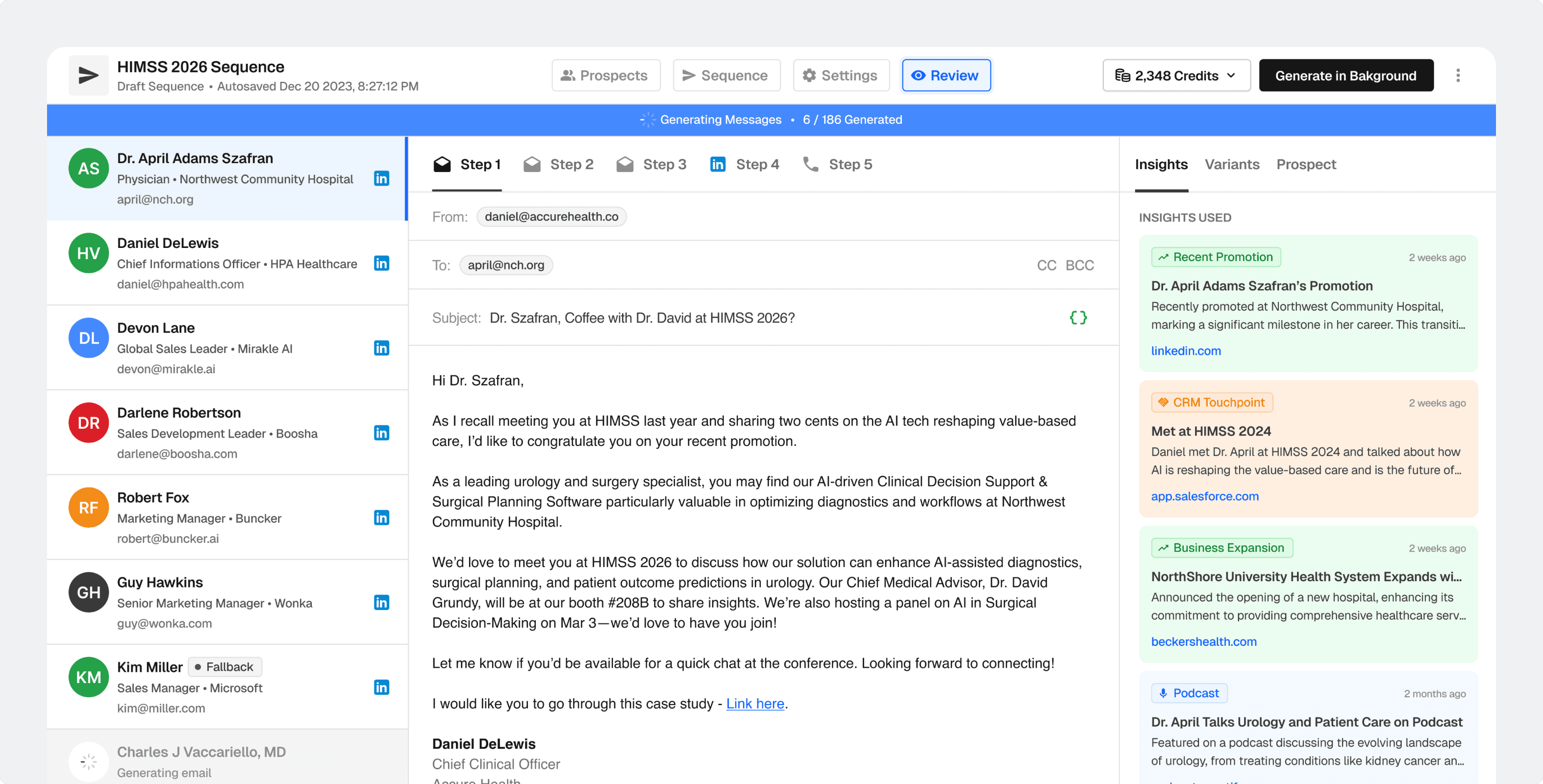
Add the prospects to a sequence. Zeus AI reads what is known about each person, such as a recent promotion, a past CRM touchpoint, news about their hospital or a podcast they joined, and drafts every step for each prospect.
A sequence can mix email, LinkedIn and calls, and replies land in one inbox. You review the drafts, edit what you want and send.
Apollo has sequences and AI email writing too. The difference is that steps 1 and 2 run on healthcare data, so step 3 starts with the right person at the right site.
“I am very inspired by the Zeus mail feature. It’s like having a hyper-personalized mail writer that’s unbelievably efficient. I love how it automatically researches prospects and writes hyper-personalized emails, saving me hours every day by eliminating manual research. […] The real value is speed and scale, as I can reach significantly more prospects every week with personalized, high-converting messages that don’t look like generic automated spam.”

Bring your territory into Dmand AI
Search your hospitals, groups and practices. See the hierarchy, the HCPs and the executives at each site. 30-day free trial, no card.
Apollo.io vs Dmand AI: comparison summary
Here is how the two compare on the things that decide a healthcare outbound program: affiliations, contact data and execution.
| Apollo.io | Dmand AI | |
|---|---|---|
| Built for | Every B2B industry | Teams selling into US healthcare |
| Contact database | 240M contacts, 30M companies | 7.4M+ HCPs, 11M+ healthcare executives, 997K+ sites of care |
| Healthcare search filters | None: job title, seniority, location, company and keywords | NPI, specialty, facility type, site of care, IDN and 100+ healthcare filters |
| HCP identifier | No NPI field | Unique NPI on every HCP |
| Org hierarchy | Company records; Apollo's guide says confirm system membership by hand | IDN to health system, hospital and site of care |
| Physician and executive affiliations | Contact linked to a company | HCPs and executives at each site, primary and secondary locations |
| Relationship intelligence (warm introductions) | Not listed | Physician Network Discovery across five path types |
| Healthcare profile data | Not listed | Procedures, Medicare claims, beds, service lines, EHR, financials |
| Intent data and buying signals | Buying intent and job change alerts | 80+ healthcare buying signals |
| Sales engagement (sequences, dialer, LinkedIn, inbox) | Sequences, parallel dialer, meetings | Email, auto-dialer, LinkedIn and task sequences, unified inbox |
| Contact enrichment API | Custom plans for advanced integrations | NPI API, up to 45 NPIs per request, credits only when found |
| AI search and MCP | AI assistant; MCP for Claude, ChatGPT and Perplexity | Natural language search, AI Research Columns, Zeus AI; Claude MCP connector |
| Free option | Free plan with no time limit | 30-day free trial, no card |
| Entry price | $49 per user per month (Basic, annual) | $249 per user per month (Kickstarter) |
| Contract | Monthly or annual; annual plans cannot downgrade mid-cycle | No contract |
Apollo.io competitors and alternatives, and who each is for
Most Apollo alternatives are other horizontal databases. For healthcare, the real choice is between a horizontal tool, a healthcare data warehouse and a healthcare-native outbound platform.
| Tool | Type | Best for |
|---|---|---|
| Apollo.io | Horizontal sales platform | Multi-industry outbound on a low per-seat budget |
| ZoomInfo | Horizontal B2B database | Corporate roles across industries, including health system finance and IT leaders |
| Lusha, Seamless.AI and similar | Horizontal contact data | Contact lookups across industries |
| Definitive Healthcare | Healthcare market intelligence | Market sizing, all-payor claims and analytics teams on custom contracts |
| Dmand AI | Healthcare sales intelligence and outbound | Teams selling into US healthcare who need site-level people, NPI and warm paths |
For the head-to-heads, read our Definitive Healthcare review and our ZoomInfo review.
Who switches from Apollo.io to Dmand AI
Teams move when healthcare stops being one segment and becomes the whole market.
Health IT and services
Health IT sellers need the CIO, CMIO and department heads at each hospital, and they need to know which system owns the contract. The hierarchy answers that before the first email, and technology installs by site show what each account runs today.
Healthtech and digital health
Digital health teams sell to the clinicians who treat a population and to the executives who sponsor pilots. Dmand AI finds HCPs by specialty, procedures and patient volume, then shows every site and group they work at.
Medical staffing and recruiting
Staffing firms work both sides: the facility leaders who hire and the clinicians they place. Search 7.4M+ HCPs by specialty, site and training, reach administrators and directors of nursing at the facility level, and pull personal emails by NPI for candidate outreach.
Consulting and agencies serving healthcare
Agencies build lists for several healthcare clients at once. Hierarchy and ownership data size a market, AI Research Columns answer client-specific questions on every row, and team workspaces with role-based access keep client work apart.
MedTech and medical supplies
Device teams need surgeons by procedure volume and the ASCs and hospitals where those procedures happen. Network Discovery adds introductions through co-investigators, co-authors and former colleagues.
Pharma, biotech and CROs
Commercial and medical affairs teams search prescribers, KOLs and investigators by specialty, prescriptions, publications and trials, then map the sites and systems above them.
Apollo.io pricing 2026 vs Dmand AI
Apollo costs less per seat. G2 shows Apollo's free plan, Basic at $49 and Professional at $79 per user per month, as provided by Apollo. Its pricing page lists Professional at $99 on monthly billing, and Custom plans are quoted. Vendr puts the median Apollo purchase at $19,000 a year across 101 deals.
Dmand AI's Kickstarter plan is $249 per user per month with 1,000 credits, and Growth is $499 with 2,500 credits. Half-yearly billing saves 10% and annual billing saves 20%. There is no contract. See dmand.ai/pricing.
For five seats on annual billing, Apollo Professional lists at about $4,740 a year and Dmand AI Kickstarter at about $11,952. The real question is what each seat returns when every account is a hospital, practice or site of care.
| Apollo.io | Dmand AI | |
|---|---|---|
| Free option | Free plan, no time limit | 30-day free trial, no card |
| Entry plan | Basic, $49 per user per month (annual) | Kickstarter, $249 per user per month, 1,000 credits |
| Mid plan | Professional, $79 per user per month (annual) or $99 (monthly) | Growth, $499 per user per month, 2,500 credits |
| Top plan | Custom, by quote | Enterprise, custom for 10+ seats |
| Billing discounts | Annual pricing below monthly | 10% off half-yearly, 20% off annual |
| Extra credits | Add-on credits that renew each cycle | $49 per 500 credits |
| Contract | Monthly or annual; no mid-cycle downgrade on annual | No contract |
| API | Custom plans | NPI enrichment API, credits only when found |
Questions to ask before you renew Apollo.io
Bring these to your renewal call.
- How many of our target hospitals show the right parent health system?
- Do our physician and nurse records carry an NPI we can match to our CRM?
- What share of our healthcare emails bounced last quarter, and what happens to the credits?
- Do unused or add-on credits carry over to the next cycle?
- Can we move from annual to monthly billing, or drop seats, before the term ends?
- Is API access in our plan, or does it need a Custom plan?
- Which healthcare triggers, such as EHR migrations or acquisitions, come to us as signals?
Ask in writing. Credit, downgrade and API answers given on a call are hard to hold a vendor to at renewal.
How to switch from Apollo.io to Dmand AI
You can test Dmand AI against your Apollo data in one afternoon.
Start the 30-day trial.
No card and no call. The trial previews the full dataset, fully searchable with trial credits.
Search 50 accounts you already sell to.
Pick hospitals, groups and practices you know well. Check the parent system, the sites and the people at each one.
Compare field by field.
Line up site, NPI, title, email and direct dial against your Apollo export.
Run Network Discovery on your top accounts.
Count how many have a warm path in through people you already know.
Plan around your Apollo term.
Annual Apollo plans cannot be downgraded mid-cycle, so time the move to your renewal date.
Apollo.io or Dmand AI: which to choose
Choose Apollo.io if healthcare is one segment among many, you want a free plan or the lowest price per seat, and your buyers are corporate roles you can find by title and company.
Choose Dmand AI if US healthcare is your market. You get HCPs by NPI, executives at the site they run, the hierarchy above every site, warm paths through Physician Network Discovery, and sequences on the same records.
Verdict: Apollo.io is a horizontal sales platform with a low entry price. For teams selling into US hospitals, health systems and practices, Dmand AI provides the healthcare data model that Apollo's own guide asks reps to build by hand.